
Best Electric Knife Sharpeners in 2026

An electric knife sharpener is for people who want sharp kitchen knives without learning to use a whetstone. Motorized abrasives do the grinding, and built-in guides hold the blade at a fixed angle, so the result depends far less on technique. A dull chef’s knife can go from crushing tomatoes to slicing them in a few minutes.
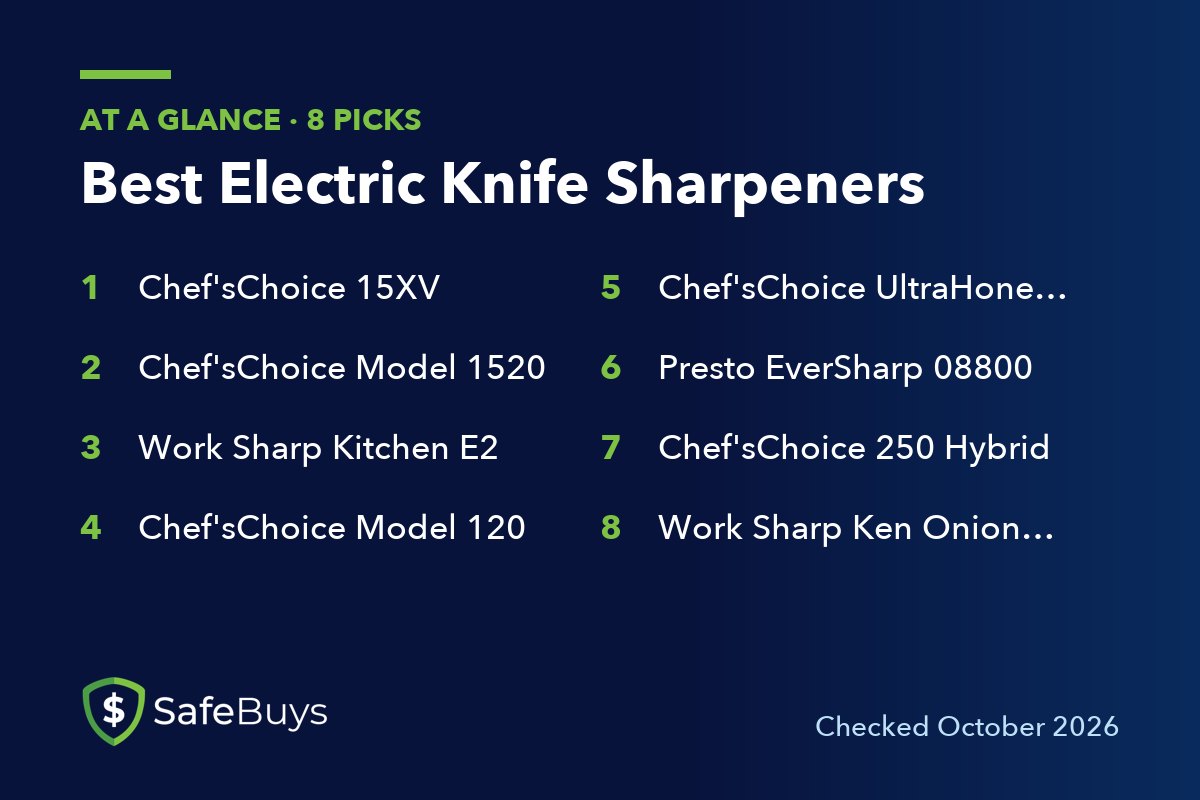
The best electric knife sharpener for most home kitchens is the Chef’sChoice 15XV, a three-stage diamond sharpener that puts a 15-degree edge on both Western and Japanese-style knives. If you own a mix of 15 and 20-degree knives and want to keep each at its factory angle, get the Chef’sChoice Model 1520. For a simpler machine at half the price, the Work Sharp Kitchen Electric Knife Sharpener is the value pick.
Last checked October 2026: availability, specs and prices.
What to Look for in an Electric Knife Sharpener
Edge angle. Most European and American knives leave the factory with roughly a 20-degree edge on each side. Most Japanese knives, and many newer Western ones, use about 15 degrees. A sharpener set for the wrong angle will reshape the edge. Choose between one fixed angle, both, or an adjustable guide.
Number of stages. Two-stage sharpeners grind and then hone. Three-stage models add a finer finishing or stropping step, which gives a more polished edge and lets you touch up a knife without removing much metal.
Abrasive type. Diamond-coated disks cut quickly and work on very hard steel. Ceramic disks and wheels cut more gently. Flexible abrasive belts, borrowed from workshop sharpeners, offer the most control but ask more of the user.
Guides. Spring-loaded or slotted guides keep the blade at the right angle through the whole stroke. This is the feature that makes electric sharpeners beginner friendly, so look for it on any model you consider.
Serrated knives and other blades. If you want to maintain a bread knife, check that the manufacturer lists serrated blades. A few sharpeners also handle scissors, pocket knives or cleavers.
Warranty. Sharpeners in this guide carry one to three years of coverage.
Best Electric Knife Sharpeners in 2026: Our Picks
The eight sharpeners below were all listed for sale new on their manufacturers’ US stores in October 2026.
1. Chef’sChoice 15XV Electric Knife Sharpener
The Chef’sChoice 15XV is built around one idea: converting traditional 20-degree factory edges into sharper 15-degree edges, and refining knives that already have them. Its three stages produce what the company calls the Trizor XV edge, a triple-bevel shape designed to combine sharpness with durability.
Stage 1 shapes the edge with 100% diamond abrasives, stage 2 refines it and stage 3 polishes. Flexible spring guides hold the knife at the correct angle from heel to tip. Chef’sChoice says a first sharpening takes about one minute and that the machine handles both straight-edge and serrated knives. It costs about $166 (October 2026) with a three-year limited warranty.
Pros of Chef’sChoice 15XV
- Three stages with diamond abrasives and a polishing step
- Spring guides keep the angle consistent
- Works on straight and serrated blades
- Three-year limited warranty
Cons of Chef’sChoice 15XV
- 15 degrees only: it will reprofile thicker 20-degree knives
- The first conversion from 20 to 15 degrees removes more metal than a routine sharpening
- Among the more expensive home models
2. Chef’sChoice Model 1520 AngleSelect
The Chef’sChoice Model 1520 is the choice for a mixed knife block. Its first stage sharpens 15-degree knives and its second stage sharpens 20-degree knives, so a Japanese santoku and a German chef’s knife can each keep their original geometry. The third stage uses stropping disks to polish either type.
The abrasives are 100% diamond, and precision guides position the blade through the full stroke. The manufacturer puts first-time sharpening at about one minute and resharpening at about 10 seconds, and lists serrated knives as compatible. It is priced at about $190 (October 2026) and carries the same three-year limited warranty as the 15XV.
Pros of Chef’sChoice Model 1520
- Separate stages for 15 and 20-degree knives
- Stropping stage for a polished finish
- Quick touch-ups once the edge is set
Cons of Chef’sChoice Model 1520
- You need to know which angle each of your knives uses
- Costs more than the 15XV
3. Work Sharp Kitchen Electric Knife Sharpener
The Work Sharp Kitchen Electric Knife Sharpener, also known as the E2, is the simplest machine here to use. Flexible sharpening discs with 120-grit ceramic abrasives do the grinding, guides lock in a 20-degree angle, and a built-in timer shuts the unit off when the cycle is done. You pull the knife through until it stops.
A fine ceramic honing wheel on the unit refines the edge and handles quick maintenance between full sharpenings. Work Sharp lists serrated blades and scissors as supported. At 1.2 pounds it is small enough for a drawer. It costs about $88 (October 2026) with a three-year warranty, and Work Sharp says it is designed, engineered and calibrated at its facility in Ashland, Oregon.
Pros of Work Sharp Kitchen Electric
- Timer-controlled cycle takes out the guesswork
- Sharpens serrated knives and scissors
- Compact, light and backed for three years
Cons of Work Sharp Kitchen Electric
- 20-degree guides only, so not ideal for thin Japanese edges
- One sharpening grit plus a hone, with no separate polishing stage
4. Chef’sChoice Model 120 3-Stage Professional
The Chef’sChoice Model 120 is the 20-degree counterpart to the 15XV. If your kitchen is stocked with classic European or American knives and you want to keep their sturdier edges, this is the three-stage model to buy.
The first stage reshapes the edge with coarse diamond abrasives, the second sharpens with medium abrasives, and the third uses stropping disks for a polished finish. The result is three facets set at different angles, which Chef’sChoice says lasts longer than a simple V-shaped edge. Angle guides run the full length of the blade, and serrated knives are supported. It is listed at about $190 (October 2026).
Pros of Chef’sChoice Model 120
- Three stages tuned for 20-degree knives
- Coarse first stage can restore badly dulled edges
- Handles serrated blades
Cons of Chef’sChoice Model 120
- Not suited to 15-degree Japanese knives
- Same price as the more flexible Model 1520
5. Chef’sChoice Diamond UltraHone (Model 312)
The Chef’sChoice Diamond UltraHone is a compact two-stage sharpener for 20-degree straight and serrated knives. Stage 1 uses fine diamond abrasives to set the first bevel. Stage 2 hones with micron-size diamond abrasives to finish a second bevel.
Chef’sChoice says the conical disks apply gentle pressure and will not detemper the blade, meaning they will not overheat the steel. Guides position and steady the knife automatically. The company lists kitchen, household, sporting and pocket knives as suitable. It is engineered and assembled in the USA, covered for three years, and costs about $100 (October 2026).
Pros of Chef’sChoice Diamond UltraHone
- Diamond abrasives in both stages
- Small footprint
- Three-year limited warranty
Cons of Chef’sChoice Diamond UltraHone
- No coarse stage for chipped or very dull knives
- 20-degree class knives only
6. Presto EverSharp Electric Knife Sharpener (08800)
The Presto EverSharp 08800 is the budget pick at about $49 (October 2026) on Presto’s own site. It is a two-stage sharpener: the first stage grinds a precisely angled edge and the second hones and polishes it.
Presto uses Sapphirite sharpening wheels, which it describes as the same ultra-hard material used by professional sharpening shops. Blade guides hold the knife at the sharpening angle. Presto says it suits most kitchen and sporting knives. The warranty is one year. For an inexpensive knife set that needs a working edge a few times a year, this does the job at a fraction of the price of the diamond machines.
Pros of Presto EverSharp 08800
- Lowest price in this guide
- Simple two-stage process with blade guides
Cons of Presto EverSharp 08800
- One-year limited warranty
- Presto’s page does not state the angle or mention serrated knives
- No fine polishing stage
7. Chef’sChoice 250 Hybrid Knife Sharpener
The Chef’sChoice 250 Hybrid splits the work between a motor and your hand. Stages 1 and 2 are electric: the first shapes the edge with diamond abrasives and the second refines it. Stage 3 is a manual slot where you pull the blade through to polish it.
That design keeps the price to about $60 (October 2026) while still producing a triple-bevel edge. Chef’sChoice lists straight-edge, serrated, cleaver and sports knives as compatible. It is made in the USA and has a three-year limited warranty, which is generous for the price.
Pros of Chef’sChoice 250 Hybrid
- Diamond abrasives and three stages at a low price
- Handles serrated knives and cleavers
- Three-year limited warranty
Cons of Chef’sChoice 250 Hybrid
- The final stage is manual
- Not a fully powered sharpener, so finishing takes a bit more effort
8. Work Sharp Ken Onion Edition Knife & Tool Sharpener Mk.2
The Work Sharp Ken Onion Edition Mk.2 is a different kind of tool: a handheld belt sharpener with an adjustable guide that sets any angle from 15 to 30 degrees. It ships with 3/4 x 12-inch belts in five grits, from extra coarse to extra fine, and a seven-speed motor with an LED display.
Work Sharp lists kitchen cutlery, pocket and hunting knives, serrated blades, scissors, axes and other edged tools. This is the sharpener for someone who wants one machine for the kitchen, the garage and the tackle box, and who is willing to practice. It weighs 3.3 pounds, has a three-year warranty and costs about $200 (October 2026).
Pros of Work Sharp Ken Onion Mk.2
- Adjustable 15 to 30-degree guide
- Five belt grits and seven speeds
- Sharpens tools and outdoor blades as well as kitchen knives
Cons of Work Sharp Ken Onion Mk.2
- Steeper learning curve than slot-style sharpeners
- Belts wear out and need replacing
- Highest price here
Electric Knife Sharpener Questions Buyers Ask
Do electric knife sharpeners damage knives?
They remove metal, as every sharpening method does. The risk comes from using a coarse stage too often. Use the first stage only when a knife is truly dull and rely on the finishing stage for routine touch-ups.
Should I choose a 15 or 20-degree sharpener?
Match your knives. Japanese-style knives and thin slicers generally use 15 degrees. Heavier European and American knives generally use 20. If you own both, a dual-angle model such as the Chef’sChoice 1520 avoids reprofiling either.
Can an electric sharpener handle serrated knives?
Many can. Chef’sChoice lists serrated knives for the 15XV, 1520, 120, 312 and 250, and Work Sharp lists them for both of its models here. Serrated blades are usually sharpened in the final stage only.
How often should kitchen knives be sharpened?
It depends on use. A common approach for home cooks is a full sharpening a few times a year, with a quick pass through the honing stage whenever the knife starts to drag.
Conclusion
Buy the Chef’sChoice 15XV if you want the sharpest practical edge on most kitchen knives and do not mind standardizing on 15 degrees. Choose the Chef’sChoice Model 1520 if you want to keep 15 and 20-degree knives at their own angles.
The Work Sharp Kitchen Electric Knife Sharpener is the best value for cooks who want a push-button routine, and the Presto EverSharp 08800 is the one to buy on a strict budget. If you sharpen more than kitchen knives, the Work Sharp Ken Onion Edition Mk.2 covers almost anything with an edge.