Best Kids Headphones in 2026

Kids headphones are not just smaller adult headphones. The good ones cap the volume so a child cannot turn a tablet up to a level that harms hearing over time, and they are built to survive being sat on, dropped and stuffed in a backpack.
The top pick for most families is the Puro Sound Labs BT2200-Plus, which limits volume to 85 dB. Puro lists no higher setting. If you want to spend far less, the JLab JBuddies Studio 2 Wireless costs about $30, and the JBL Junior 470NC is the pick for parents who want to set limits from a phone app.
Last checked October 2026: availability, specs and prices.
What to Look for in Kids Headphones
The volume limit, and whether it can be bypassed. Most kids headphones cap output at 85 dB, the figure Puro Sound Labs ties to World Health Organization guidance. Some models add a higher setting of 94 or 95 dB for noisy places such as planes. A switch a child can reach is a switch a child will find, so check where the limit is set.
Wired or wireless. Bluetooth removes the cable that younger kids chew, snag and yank. A wired mode is still useful for airplane screens and school laptops. Be aware that on some headphones the limit only applies over Bluetooth or only with the maker’s own cable.
Fit and age range. On-ear models are light and small. Over-ear models block more outside sound. Makers publish age ranges, and they differ a lot, so match the range to your child.
Noise cancelling. Kids turn the volume up to hear over engine or classroom noise. Passive isolation or active noise cancelling (ANC) lowers that background noise, so the limit feels loud enough.
Sharing. Siblings on a road trip will want to watch the same screen. Look for a wireless share mode or a daisy-chain cable that links two pairs.
Battery and durability. Twenty hours covers a long travel day. A foldable frame, a case and a warranty longer than a year all help the headphones last.
Best Kids Headphones: Our Picks
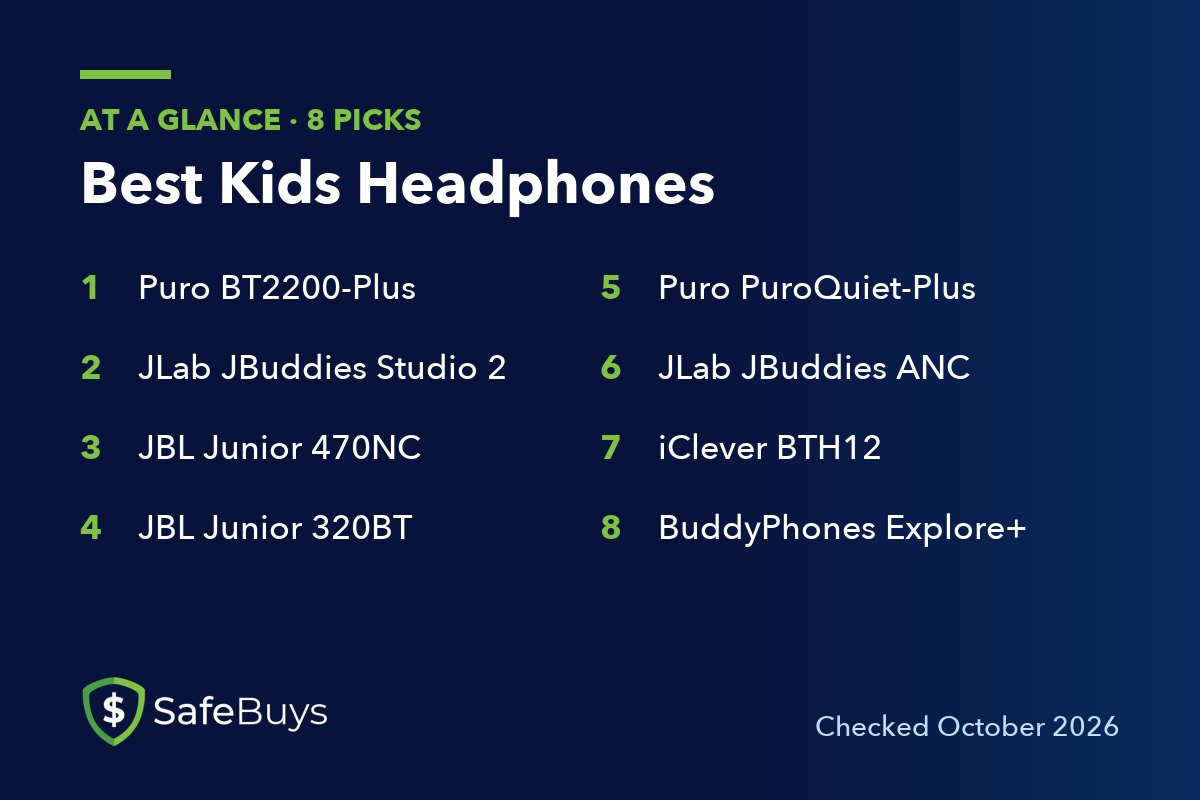
The eight picks below all have a volume limit stated by the maker or the retailer listing, and all were on sale new in October 2026. Each section gives the stated limit.
1. Puro Sound Labs BT2200-Plus
The Puro Sound Labs BT2200-Plus is built around hearing safety. Puro limits it to 85 dBA and tunes it so music still sounds full at that level. The company says the passive design blocks 83% of ambient noise at 1 kHz, which reduces the urge to turn it up.
The headphones are on-ear by default, and Puro includes a second set of ear cups that turns them into over-ear headphones for a better seal. The box also holds a hard case, a volume-limiting audio cable for wired use and a daisy-chain cable so two Puro pairs can share one device. Battery life is rated at 20 hours over Bluetooth 5.1, with USB-C charging and a one-year warranty. The price is about $99 (October 2026).
Pros of the BT2200-Plus
- 85 dBA volume limit, the only setting Puro lists
- On-ear and over-ear cushions in the box
- Limiter cable keeps the cap in wired mode
- Hard case and sharing cable included
Cons of the BT2200-Plus
- The most expensive non-ANC pick here
- 20-hour battery is short next to cheaper rivals
- One-year warranty
2. JLab JBuddies Studio 2 Wireless
The JLab JBuddies Studio 2 Wireless is the value pick at about $30 (October 2026). It is a foldable on-ear headphone that JLab recommends for ages 6 and up, with a rated playtime of more than 65 hours.
JLab’s Volume Safe setting has two positions: 85 dB and 95 dB. The lower one is the right choice for daily use. A Wireless Share mode links two pairs to one device with no cable, and the headphones also work wired. JLab covers them with a two-year warranty.
Pros of the JBuddies Studio 2 Wireless
- Very low price
- 65+ hours of rated battery life
- Wireless Share mode for two listeners
- Two-year warranty
Cons of the JBuddies Studio 2 Wireless
- The limit can be switched up to 95 dB
- On-ear fit blocks little outside noise
- Rated for ages 6+, so not for toddlers
3. JBL Junior 470NC
The JBL Junior 470NC is an over-ear model with active noise cancelling. According to the listing at Abt, it is designed never to exceed 85 dB, and parents can set a lower custom limit in the JBL Headphones app. The same app can cap daily listening time, shows daily and weekly usage and volume reports, and locks the settings behind a PIN.
Battery life is listed at up to 50 hours, or 28 hours with Bluetooth and ANC on. JBL’s own site blocked automated checks, so these details come from Abt, which had it in stock at about $65 (October 2026).
Pros of the Junior 470NC
- 85 dB cap that parents can lower in the app
- Listening-time limits and usage reports
- Active noise cancelling
- Up to 50 hours of battery
Cons of the Junior 470NC
- The best features need the app set up on a parent’s phone
- Over-ear size may be large for the youngest kids
4. JBL Junior 320BT
The JBL Junior 320BT is the on-ear sibling of the 470NC and costs less. Abt’s listing shows the same 85 dB ceiling and the same app controls: a lower custom volume cap, a daily listening limit and usage reports.
It folds flat for a backpack, has oversized buttons for small hands, a built-in microphone and a 50-hour battery rating. JBL includes a sticker set for decorating the ear cups. Abt had it at about $45 (October 2026).
Pros of the Junior 320BT
- App-based parental controls at a low price
- 50-hour rated battery
- Folds flat, with large child-friendly buttons
Cons of the Junior 320BT
- No noise cancelling
- On-ear pads let in more outside sound
5. Puro Sound Labs PuroQuiet-Plus
The Puro Sound Labs PuroQuiet-Plus adds active noise cancelling to Puro’s 85 dBA limit. Puro says the ANC makes background sound up to 22 dB quieter, which makes this the pick for flights and long car rides.
Battery life is rated at 35 hours with ANC off and 23 hours with it on. A built-in microphone handles online lessons and calls. Like the BT2200-Plus, it ships with a hard case, a volume-limiting cable and a daisy-chain cable. It costs about $119 (October 2026).
Pros of the PuroQuiet-Plus
- ANC combined with a fixed 85 dBA limit
- Up to 35 hours per charge
- Case and limiter cable included
Cons of the PuroQuiet-Plus
- The highest price in this guide
- On-ear design, where over-ear would isolate better
6. JLab JBuddies ANC
The JLab JBuddies ANC brings noise cancelling down to about $32 (October 2026). JLab says it is designed for kids ages 2 and up, with an adjustable headband and a foldable frame.
It uses the same Volume Safe switch as the Studio 2, with 85 dB and 95 dB positions. Playtime is rated at more than 48 hours, it works wired over a 3.5mm cable or wirelessly, and the Wireless Share mode links two pairs. The warranty is two years.
Pros of the JBuddies ANC
- Active noise cancelling for about $32
- Rated for ages 2 and up
- Wireless Share mode
Cons of the JBuddies ANC
- 95 dB position is available on the switch
- JLab does not publish how much noise the ANC removes
7. iClever BTH12
The iClever BTH12 is an over-ear Bluetooth headphone with light-up ear cups. iClever lists two volume limits, 74 dBA and 85 dBA, so parents can pick the quieter setting for younger children.
The battery is rated at 85 hours with the lights off. There are four RGB lighting modes, a built-in microphone, a wired mode, USB-C charging and a foldable frame. It costs about $40 (October 2026).
Pros of the BTH12
- 74 dBA option, the lowest limit in this guide
- 85 hours of rated playtime with the lights off
- Over-ear cushions at a budget price
Cons of the BTH12
- Lights shorten battery life
- No noise cancelling
8. Onanoff BuddyPhones Explore+
The Onanoff BuddyPhones Explore+ is the wired pick. There is no battery to charge and nothing to pair, which suits school use and younger kids. Onanoff caps the volume at 85 dB and recommends it for children aged 3 to 10.
The cable has an in-line microphone with a control button. Onanoff’s BuddyCable system uses a stackable audio jack so up to four headphones can connect to one device. The headband folds and is cushioned. It costs about $30 (October 2026).
Pros of the BuddyPhones Explore+
- No charging or pairing
- 85 dB limit built in
- Up to four pairs can share one device
Cons of the BuddyPhones Explore+
- Needs a headphone jack or an adapter
- Cables are the part most likely to break
Kids Headphones: Common Questions
What volume limit is safe for kids?
Most makers use 85 dB as the ceiling. Time matters as well as level, which is why the JBL app’s daily listening limit is useful. If your child is very young, the 74 dBA setting on the iClever BTH12 gives extra margin.
Are volume-limited headphones loud enough on a plane?
Often not, on their own. That is why some models offer a 94 or 95 dB mode. A better fix is noise cancelling, which lowers the cabin noise so 85 dB is enough. The PuroQuiet-Plus, JBL Junior 470NC and JLab JBuddies ANC all have it.
Does the limit still work with a cable?
It depends on the model. Puro includes a dedicated limiter cable for wired listening. With other brands, check the manual before relying on the limit in wired mode.
At what age can a child use headphones?
Follow the maker’s range. Among these picks, JLab rates the JBuddies ANC for ages 2 and up, Onanoff rates the Explore+ for ages 3 to 10, and JLab rates the JBuddies Studio 2 for ages 6 and up.
Conclusion
Buy the Puro Sound Labs BT2200-Plus if you want a fixed 85 dB limit, a case and both cushion types in one box. Step up to the PuroQuiet-Plus if your child flies often and needs noise cancelling.
Parents who want control from their own phone should pick the JBL Junior 470NC, or the JBL Junior 320BT to save money. On a tight budget, the JLab JBuddies Studio 2 Wireless and JLab JBuddies ANC are hard to beat, as long as you keep the switch at 85 dB. The iClever BTH12 suits kids who want lights and long battery life, and the Onanoff BuddyPhones Explore+ is the simple wired option for school.