

Yamaha HS7 vs HS8: Main Differences and Similarities

Whether it is a film score or a pop single, what you hear always depends on the hardware playing it back. That is why a mix that sounds great in one room can fall apart in the car or on earbuds. Studio monitors exist to fix that problem. They are built to show you what is really in the recording, flaws included, so the final mix translates everywhere else.
Yamaha has been part of this story for decades. Its NS-10M became a fixture in recording studios, and the company has made powered monitors for home studios and professional rooms ever since. Today, the HS series is its best-known line, and two of its models get compared more than any others: the HS7 and the HS8.
Updated September 2026: product availability, specs and prices re-checked.
Yamaha HS7 vs HS8: Differences and Similarities
The current HS series from Yamaha includes the HS5, HS7 and HS8 powered monitors, plus the HS8S subwoofer. Both the HS7 and the HS8 are still listed on Yamaha’s site in September 2026, so nothing here has been replaced. Yamaha also sells “I” versions (HS7I and HS8I) with mounting points on four sides for installs, sold as single units.
The HS7 and HS8 share the same design brief. The main differences are woofer size, amplifier power, low-end reach and cabinet size. That makes the choice mostly about your room and what you mix, not about quality. Here is how they compare.
Design
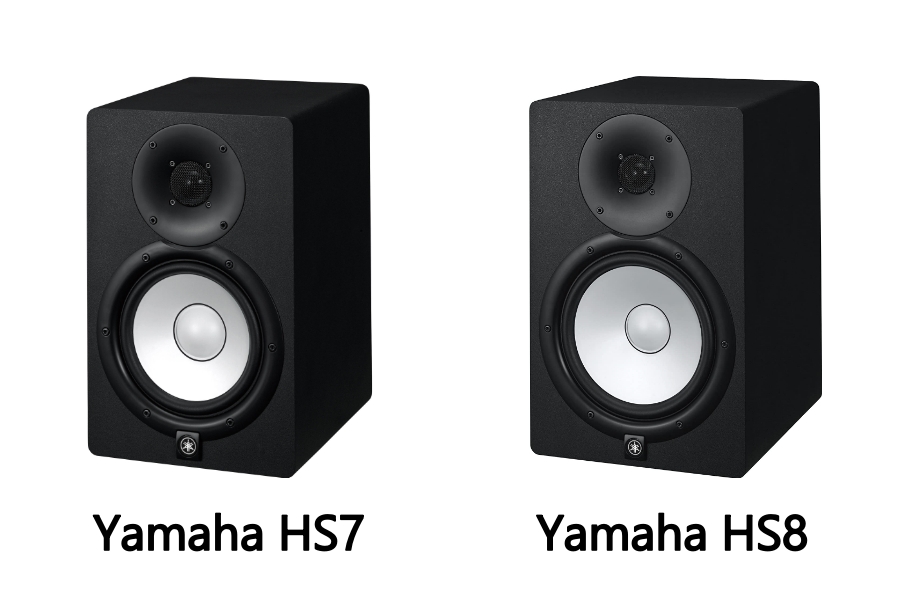
Side by side, the two look almost identical. Both have the white woofer that Yamaha monitors are known for, a 1-inch dome tweeter, and an MDF cabinet. Yamaha says the cabinets use a three-way mitered joint, borrowed from its piano-building work, to cut unwanted resonance.
Both are bass-reflex designs, meaning they have a port that helps the woofer reach lower. Yamaha says it worked on the port design to reduce the noise that ports can add, which it calls noise reduction technology. This is a change in philosophy from the old NS-10M, which used a sealed box and was known for its lean bass.
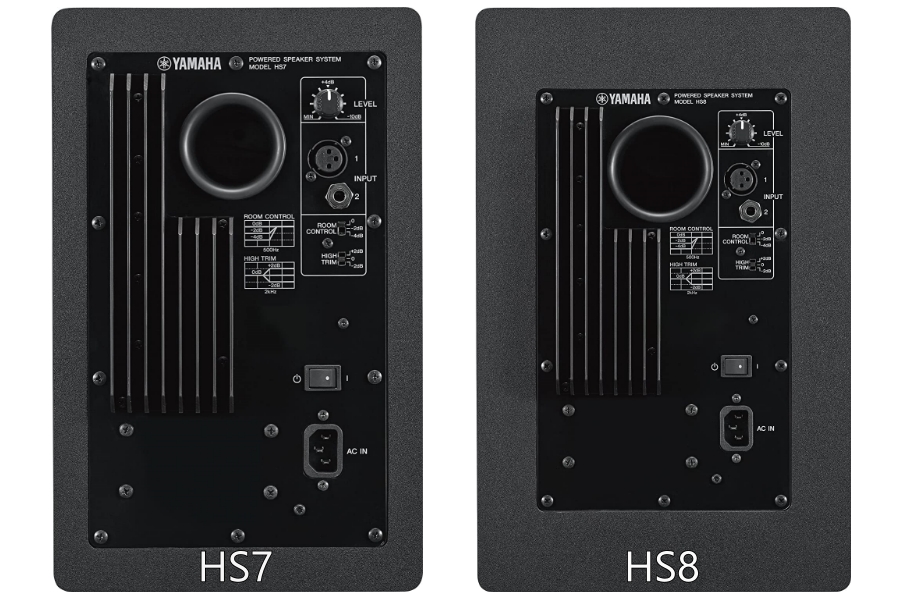
The rear panels are the same on both models. You get:
- A LEVEL control with a center click
- A ROOM CONTROL switch (0, -2 or -4 dB below 500 Hz) to tame bass buildup when the speaker sits near a wall
- A HIGH TRIM switch (plus or minus 2 dB) to adjust the treble
- Balanced XLR and TRS inputs that also accept unbalanced sources
The ROOM CONTROL switch matters more than it looks. Put a monitor close to a wall and the bass tends to swell, which leads you to mix too little bass. Cutting a few decibels below 500 Hz helps correct for that.
On design, this is a tie. Both models do the same things in the same way. The difference is size, which comes next.
Build
Studio monitors are a long-term purchase, so construction matters. Both models are bi-amplified, with one amplifier for the woofer and another for the tweeter. The crossover point is 2 kHz on both.
The physical gap is bigger than photos suggest. Yamaha lists these specs:
- HS7: 6.5-inch woofer, 95 W total (60 W low, 35 W high), 8.3 x 13.1 x 11.2 inches (W x H x D), 18.1 lbs
- HS8: 8-inch woofer, 120 W total (75 W low, 45 W high), 9.8 x 15.4 x 13.1 inches (W x H x D), 22.5 lbs
The HS8 is more than 2 inches taller and nearly 2 inches deeper. That matters on a desk. Monitors should sit with the tweeters roughly at ear height and away from the back wall, and a deep cabinet makes that harder on a small desk. Speaker stands are one common way around it.
Setup is simple for both. Neither has Bluetooth or USB. You connect them to an audio interface or mixer with XLR or TRS cables, set the rear switches for your room, and that is it. If you have used powered monitors before, nothing here will surprise you.
Build quality is a tie too. You are choosing a size, not a better-made speaker.
Audio Quality
slant.co
This is where the two actually differ. Yamaha designs the HS series for accuracy. The company’s own pitch is that the monitors should sound honest rather than flattering, so you can hear problems in a mix instead of having them covered up.
Both use a 1-inch dome tweeter and reach 30 kHz at the top. The difference is at the bottom. Yamaha rates the frequency response like this:
- HS7: 43 Hz to 30 kHz (-10 dB), 55 Hz to 24 kHz (-3 dB)
- HS8: 38 Hz to 30 kHz (-10 dB), 47 Hz to 24 kHz (-3 dB)
So the HS8 reaches about 8 Hz lower at the -3 dB point. It also has more power behind the woofer. If you make hip-hop, electronic music or anything where the kick and sub bass carry the track, the HS8 lets you hear more of that range without adding a subwoofer.
More bass is not always better, though. In a small, untreated room, low frequencies bounce around and build up in corners. A bigger woofer can make that worse, and you end up mixing around room problems instead of the music. In a small bedroom studio, the HS7 is often the easier monitor to live with. Its bass is lighter, but what you hear is more likely to be real.
If you like the HS7 but need more low end later, Yamaha sells the HS8S subwoofer, rated at 22 Hz to 160 Hz. That lets you start with the smaller monitors and add bass when your room or budget allows.
Yamaha HS7 vs HS8: Verdict
Both monitors are still current in 2026, and both do the same job well. The right one depends on your space.
Choose the HS7 if you work in a small or medium room, your desk is shallow, or your room has little acoustic treatment. You can add the HS8S subwoofer later if you need more bass.
Choose the HS8 if you have a larger room, room to place the speakers well away from walls, and you make bass-heavy music. It gives you more low end without a separate sub.
If your room is very small, or your monitors will sit less than a few feet from your ears on a compact desk, it is worth looking one step down the range. The HS5 uses a 5-inch woofer and 70 W of power, and Yamaha rates it at 54 Hz to 30 kHz (-10 dB). It gives up more bass than the HS7 but takes up even less space, and it shares the same rear-panel controls.
Before you buy, ask yourself three questions. How big is your room? What kind of music do you mix? How much space is on your desk? The answers will point you to one of the two.
Featured image: edman-news.com