

Best Siglent Oscilloscope | Review and Comparison of Models

Oscilloscopes are devices that draw electronic signals as waves over a span of time. You can then measure those waves for properties such as amplitude, frequency, rise time and distortion. There are many manufacturers, and one of the best known in the budget and mid-range market is Siglent. All oscilloscopes do the same basic job, but picking the best Siglent oscilloscope is harder than it looks. The models differ in features that some buyers need and others never use.
Siglent has built a solid reputation for these instruments. In this Siglent oscilloscope review, we look at three of its most popular models: the SDS1202X-E, SDS1204X-E and SDS1104X-E. All three are still sold in 2026.
Updated September 2026: product availability, specs and prices re-checked.
1. Siglent Oscilloscope SDS1202X-E
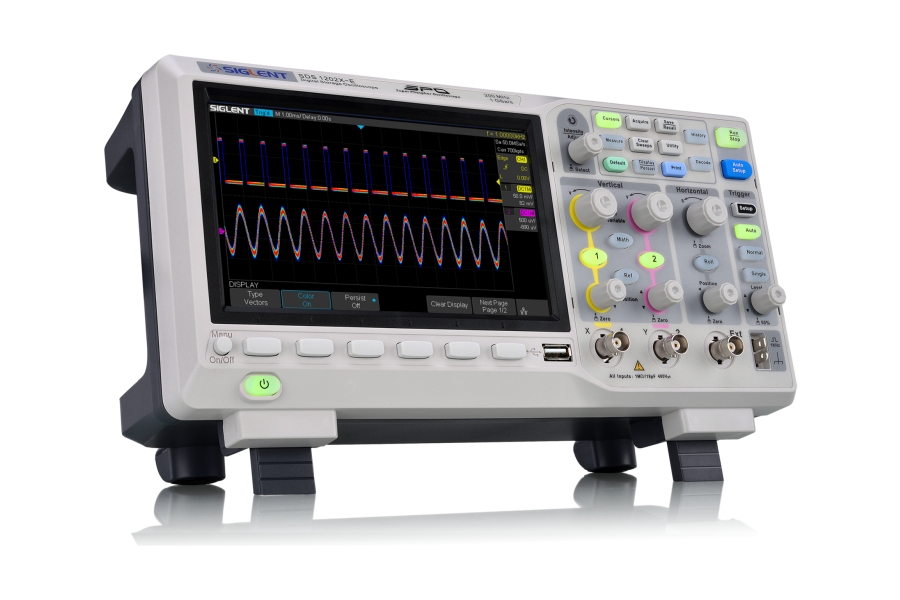
The Siglent SDS1202X-E is one of Siglent’s best-selling scopes. It is built on Siglent’s Super Phosphor Oscilloscope (SPO) technology, which is designed for strong signal fidelity and performance. It is compact and light, and Siglent rates it to capture up to 100,000 waveforms per second in normal mode and 400,000 per second in sequence mode.
The 7-inch display supports 256-level intensity grading and a color temperature mode, which make it easier to read how often a signal takes a given path. The record length is up to 14 Mpts, and the vertical sensitivity goes down to 500 µV/div, which helps with small signals.
It also supports history waveform recording and sequence triggering, so you can record long stretches of activity and go back through them. The 1 Mpt FFT gives fine frequency resolution when you look at a signal’s spectrum. Serial bus triggering and decoding come standard. At about $379 (September 2026) on Siglent’s North American store, it remains one of the best-value 200 MHz scopes available.
Key Features:
- Support for multiple interface types: USB Host, USB Device (USBTMC), LAN (VXI-11), Pass/Fail, Trigger Out;
- A 200MHz bandwidth with 2 channels;
- A real-time sampling rate of 1GSa/s;
- Multiple trigger modes, including Edge, Slope, Pulse Width, Window, Runt, Interval, Dropout, Pattern, and Video;
- Support for Statistics, Zoom measurement, Gating measurement, Math measurement, History measurement, and Ref measurement.
2. Siglent Oscilloscope SDS1204X-E
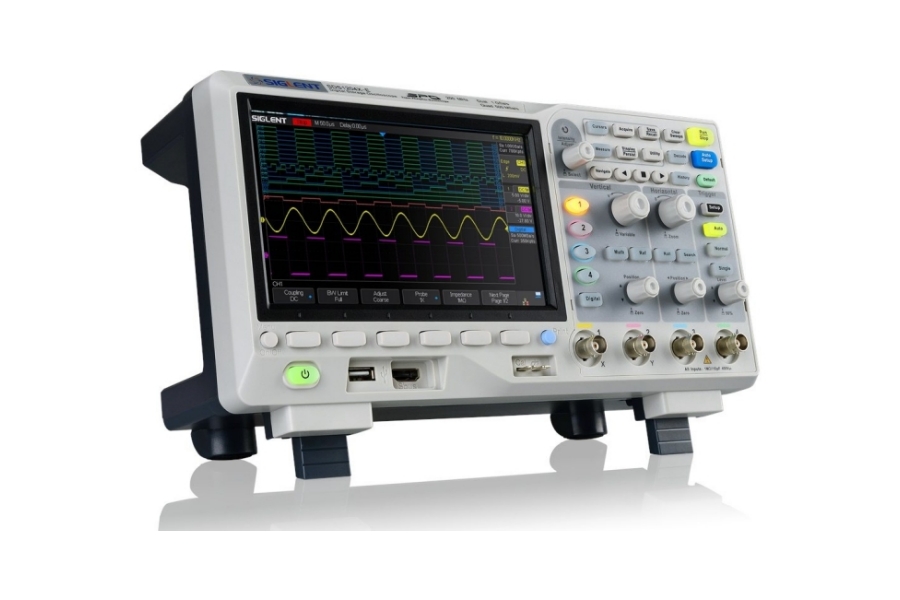
The Siglent SDS1204X-E takes the 1202X-E a step further. It keeps the 200 MHz bandwidth but has four channels instead of two. Like the 2-channel version, it has a compact, light body and a 7-inch color display. Memory is up to 14 Mpts, and it can trigger on and decode I2C, SPI, UART, CAN and LIN buses.
Other standard features include a wide range of math functions and automatic measurements on captured data. It also has the 1 Mpt FFT. In short, everything the 2-channel version offers is standard here as well.
A few things set it apart. It uses two A/D converters, each shared by a pair of channels. That lets it sample at 1 GSa/s when you use one channel from each pair. The four-channel models in this series can also drive an optional external USB signal generator and support remote control through a web browser. Despite the extra features, it is as easy to operate as other Siglent scopes. It is the priciest of the three, at about $775 (September 2026) from Siglent North America.
Key Features:
- A 200 MHZ bandwidth;
- Several trigger types, including Edge, Slope, Pulse Width, Window, Runt, Interval, Dropout, Pattern, and Video;
- Several interfaces, including USB Host, USB Device, LAN, Pass/Fail, Trigger Out, Sbus (Siglent MSO).
3. Siglent Oscilloscope SDS1104X-E
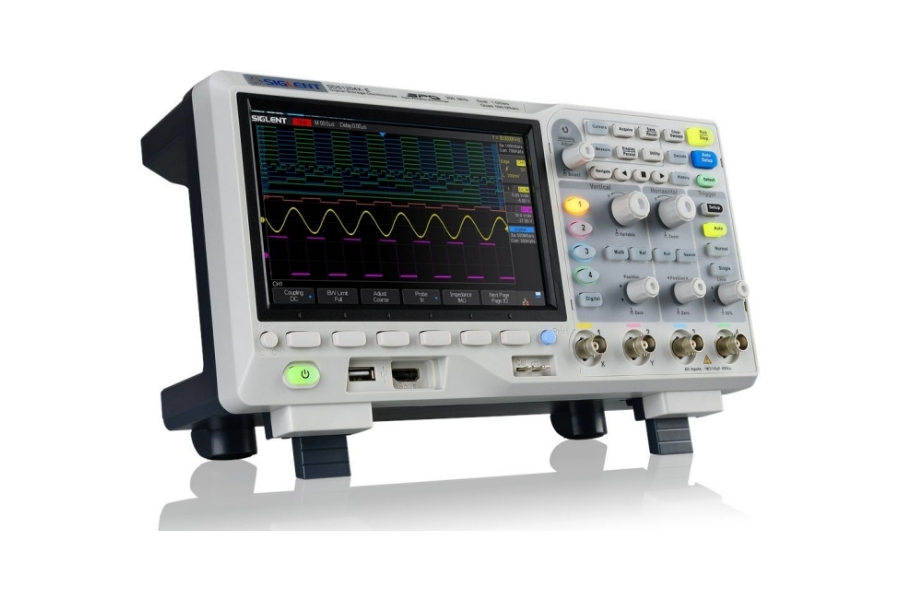
The Siglent SDS1104X-E is the last model in this Siglent oscilloscope review. It belongs to the same SDS1000X-E series. Some buyers see it as a step down from the first two, but it has real strengths over the 1202X-E. It has four channels, like the 1204X-E, and its dual A/D converters sample at 1 GSa/s (500 MSa/s when all channels are active). Maximum record length is 14 Mpts.
It is also built on Super Phosphor Oscilloscope (SPO) technology. Extra features include search and navigate functions, Bode plots (with an external Siglent signal generator) and remote control from a web browser. An optional add-on turns it into a mixed-signal scope with 16 digital channels.
Its main limit is bandwidth. At 100 MHz, it has half the bandwidth of the 1202X-E. If you need the same four channels at 200 MHz, that is the SDS1204X-E. Price is no longer a drawback. At about $499 (September 2026), it costs far less than the 1204X-E. Note that Siglent North America listed it on backorder at the time of this update.
Key Features:
- Record length of 14 Mpts/CH in interleave mode and 7 Mpts/CH in normal mode;
- Waveform capture rate of up to 100,000 wfm/s in normal mode and 400,000 wfm/s in sequence mode;
- Trigger types include Edge, Slope, Pulse Width, Window, Runt, Interval, Dropout, Pattern, and Video;
- Bode plot with an external Siglent signal generator.
What to Look For
Start with bandwidth. A scope should have several times the bandwidth of the fastest signal you plan to measure. Then decide how many channels you need. Two is enough for most hobby work, but four helps when you debug a bus with clock, data and chip select lines at the same time.
It is also worth knowing that Siglent now sells a newer line, the SDS800X HD. It uses 12-bit converters instead of 8-bit, samples at 2 GSa/s, and has a 7-inch touch screen and much deeper memory. Prices on Siglent North America start at about $356 for the 70 MHz 2-channel model (September 2026). If fine vertical detail matters to you, look at it next to the X-E models.
Related reading
Conclusion
These are the best Siglent oscilloscopes in the X-E range. They are very similar, but the details show small differences that could matter when you choose one: two channels or four, 100 MHz or 200 MHz, and a price gap of a few hundred dollars.
Siglent oscilloscopes are designed to be simple to operate, so both beginners and experienced users can pick them up quickly. We hope this Siglent oscilloscope review helps you make the right choice.
Featured image:electronics-lab.com