

Best Multimeters for Electronics Hobbyists in 2026

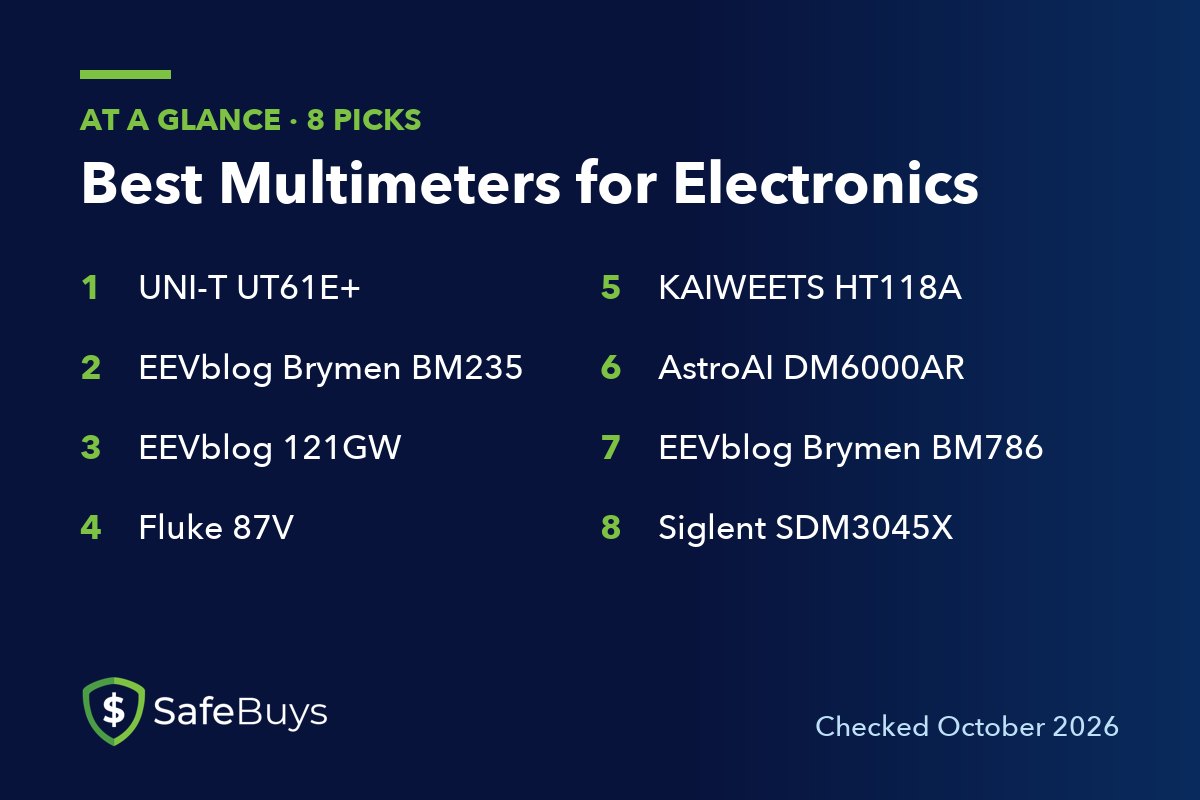
The best multimeters for electronics hobbyists are not the same meters an electrician would pick. Bench work is mostly low voltage and small currents, so resolution, microamp ranges and a fast continuity beeper matter more than a high current rating. For most hobbyists in 2026 the UNI-T UT61E+ is the best value: a 22,000-count true RMS meter with the ranges electronics work calls for.
This guide is for people building kits, repairing boards, working with microcontrollers or learning circuits. It covers eight meters, from roughly $40 handhelds to a bench unit, and explains which specs are worth paying for. If you only need to check batteries and outlets a few times a year, the two budget picks are all you need.
Last checked October 2026: availability, specs and prices.
What to Look for in Multimeters for Electronics
Counts and accuracy. Counts set the resolution. A 6,000-count meter reads a 5 V rail as 5.000 V, while a 22,000-count or 50,000-count meter adds a digit on many ranges. Basic DC voltage accuracy is the other half: budget meters are typically around 0.5%, and good electronics meters reach 0.05% or better.
Microamp and milliamp ranges. This is where electrician’s meters fall short. Measuring the sleep current of a microcontroller needs a µA range. Check the spec sheet before you buy. Fluke’s own page for the popular Fluke 115, for example, lists only 6 A and 10 A current ranges, with no mA or µA range at all.
True RMS. A true RMS meter reads AC correctly when the waveform is not a clean sine wave, which is common in electronics. Every meter in this guide is listed by its maker as true RMS.
Capacitance, frequency, diode test and temperature. Capacitance and diode test get constant use on a bench. Frequency, duty cycle and a thermocouple input are useful extras. A higher diode test voltage helps with LEDs and Zener diodes.
Continuity speed. A continuity beeper that responds immediately makes tracing a board far less tedious. Makers rarely publish a figure, so this is one area where owner reviews and teardown videos are worth checking.
Input protection and fuses. Even at a bench you will eventually probe mains. Look for ceramic HRC fuses on the current inputs and an honest CAT rating, ideally backed by independent certification. Very cheap meters often print a rating their internals cannot support.
Best Multimeters for Electronics Hobbyists: Our Picks
1. UNI-T UT61E+
The UNI-T UT61E+ sits at the top of UNI-T’s UT61+ series and is the best value for bench work. UNI-T lists a 22,000-count display, true RMS, and DC voltage accuracy of ±(0.05%+5), which is unusual at its price level.
The range list suits electronics: capacitance up to 220 mF, frequency up to 220 MHz, resistance to 220 MΩ, current up to 20 A with microamp ranges included, and a transistor hFE test. It also has USB communication for logging readings to a PC, and it runs on four AAA batteries. UNI-T’s spec table gives an AC bandwidth of 40 Hz to 10 kHz.
Pros of the UT61E+
- 22,000 counts and 0.05% basic DC accuracy
- Wide capacitance, frequency and resistance ranges
- USB output for data logging
Cons of the UT61E+
- No temperature measurement in the specs UNI-T lists for this model
- Sold mainly through third-party retailers, so prices and bundled accessories vary
- UNI-T’s spec table for the series does not show a CAT safety rating, so check the manual before using it on mains
2. EEVblog Brymen BM235
The EEVblog BM235 is a Brymen-built meter sold in a blue EEVblog edition, and it is the pick for hobbyists who want a compact meter with serious input protection. EEVblog describes it as a CAT IV rated electronics multimeter in a small form factor: 165 x 79 x 50 mm with the holster.
Brymen lists a 6,000-count display, true RMS, full µA, mA and 10 A ranges, type-K temperature, non-contact and single-probe voltage detection, and an AutoV LoZ mode that suppresses ghost voltages. The continuity function gives both a beep and a backlight flash. EEVblog includes silicone test leads with gold-plated tips, a thermocouple and batteries. It was listed at about $133 (October 2026) on the EEVblog store, which ships from Australia.
Pros of the BM235
- Robust, safety-rated design in a small case
- Full µA, mA and 10 A current ranges plus temperature
- Good silicone leads and thermocouple included
Cons of the BM235
- 6,000 counts is modest for the price
- No PC or Bluetooth connection
- No printed manual in the box, download only
3. EEVblog 121GW
The EEVblog 121GW was designed with electronics designers and hobbyists in mind, and it shows in the feature list. It has a dual 50,000-count display with bargraph, basic DC voltage accuracy of 0.05% + 5, and a 15 V diode test voltage that can light LED strings and test Zener diodes.
It also measures VA power, shows burden voltage on screen, logs data to a microSD card and connects over Bluetooth. EEVblog rates it 600 V CAT III with independent UL 61010 certification by ETL, protected by HRC fuses. It runs on four AA batteries, with a stated battery life of more than 500 hours. The meter is built by UEi Test Instruments in South Korea, and the schematic and firmware are openly published. It was about $188 (October 2026) on the EEVblog store.
Pros of the 121GW
- 50,000 counts with 0.05% basic accuracy
- 15 V diode test, low burden voltage and VA measurement
- microSD logging, Bluetooth and open schematics
Cons of the 121GW
- Bigger and heavier than the BM235
- The app situation is uneven: EEVblog points Android users to a third-party app for current phones
- More features than a beginner will use
4. Fluke 87V
The Fluke 87V is the reference meter many others are compared against. Fluke lists 6,000 counts with a 19,999-count high-resolution mode, DC voltage accuracy of ±(0.05% + 1), 10 µV maximum resolution, and current resolution down to 0.01 µA.
It measures capacitance up to 9,999 µF, frequency to 200 kHz and temperature with the included probe. It is rated CAT III 1000 V and CAT IV 600 V, and Fluke backs it with a lifetime warranty. Fluke’s store listed it at about $580 (October 2026). For a hobbyist that is a lot of money. The argument for it is durability, safety and a meter that will hold its value for decades.
Pros of the Fluke 87V
- 0.05% basic accuracy with a high-resolution mode
- Top-tier safety ratings and build
- Lifetime warranty
Cons of the Fluke 87V
- Costs several times more than meters with similar resolution
- No data logging to a PC or phone
- Large for a crowded bench
5. KAIWEETS HT118A
The KAIWEETS HT118A is the budget pick. It is a 6,000-count true RMS autoranging meter, and KAIWEETS lists current ranges from 600 µA to 10 A, resistance to 60 MΩ, plus capacitance, frequency, duty cycle and temperature from -40°C to 1000°C.
It has a 2.9-inch backlit display, non-contact voltage detection, a flashlight, and LEDs that light up the correct input jacks for the selected function, a helpful touch for beginners. KAIWEETS states a CAT III 1000 V and CAT IV 600 V rating with double ceramic fuses, and a three-year warranty. It was about $43 (October 2026) on the maker’s store.
Pros of the HT118A
- Microamp range, capacitance and temperature at a low price
- Lit input jacks reduce wrong-socket mistakes
- Three-year warranty
Cons of the HT118A
- 6,000 counts and budget-class accuracy
- The safety rating is the maker’s own claim, so treat mains work with care
- No PC connection
6. AstroAI DM6000AR
The AstroAI DM6000AR competes directly with the KAIWEETS. AstroAI lists it as a 6,000-count true RMS autoranging meter with µA, mA and 10 A current ranges, capacitance, frequency, resistance, continuity and temperature with an included thermocouple. The display is backlit.
It was about $43 (October 2026) on AstroAI’s store. AstroAI’s product page does not state a CAT rating or warranty length, which is one reason the KAIWEETS ranks above it here. As a first meter for low-voltage projects it covers the basics.
Pros of the DM6000AR
- Low price with true RMS and a microamp range
- Capacitance, frequency and temperature included
- Simple layout for beginners
Cons of the DM6000AR
- Safety rating and warranty term are not stated on the product page
- Entry-level resolution
7. EEVblog Brymen BM786
The EEVblog BM786 is the step up for hobbyists who want more digits in a rugged case. EEVblog lists it as a 60,000-count, 600 V CAT IV meter with 0.03% DC voltage, 0.085% resistance and 0.075% DC current class accuracy.
EEVblog positions it as a direct competitor to the Fluke 70 series with better accuracy and resolution. Listed features include very fast autoranging, a fast non-latched visual continuity tester, a 31-segment bargraph that updates 50 times a second, a 350 µs crest mode and AutoHold. It comes with silicone leads and a thermocouple. It was about $184 (October 2026) on the EEVblog store.
Pros of the BM786
- 60,000 counts and 0.03% basic DC accuracy
- CAT IV 600 V rating in a drop-resistant case
- Fast autoranging and continuity, per the maker
Cons of the BM786
- No Bluetooth or logging on this version
- Larger than the BM235
- Ships from Australia when bought from the EEVblog store
8. Siglent SDM3045X
The Siglent SDM3045X is a bench multimeter, mains-powered and meant to stay on the desk. Siglent lists 4½ digits (66,000 counts), DC voltage accuracy of 0.06% of reading + 8 counts over one year, and up to 150 readings per second.
The 4.3-inch color display can show histograms, trend charts, statistics and two measurements at once. It has USB host, USB device and LAN ports with SCPI control, which makes automated logging straightforward. Siglent lists it at about $399 (October 2026). It complements a handheld meter and does not replace one.
Pros of the SDM3045X
- 66,000 counts with trend and histogram views
- USB and LAN remote control
- Always on, with no batteries to run down
Cons of the SDM3045X
- Not portable
- Costs as much as an entry-level oscilloscope
- Siglent notes it is not compatible with the SC1016 scanner card
Multimeter Questions from Electronics Beginners
How many counts do I need for hobby electronics?
A 6,000-count meter is enough for most kit building and repair. Step up to 20,000 counts or more if you measure small voltage drops, trim reference voltages or characterize battery discharge.
Do I need a Fluke for electronics?
No. A Fluke 87V is excellent, but its price buys ruggedness, safety margins and a lifetime warranty more than extra resolution. Several meters here match or beat its count for much less.
Is a cheap multimeter safe?
For batteries and low-voltage circuits, yes. Be careful on mains. Stick to meters with fused current inputs, and prefer independently certified ratings, such as the 121GW’s, if you plan to measure household wiring regularly.
Conclusion
Most electronics hobbyists should start with the UNI-T UT61E+ for its resolution and range list. If you also measure mains and want strong protection in a compact body, buy the EEVblog BM235. The EEVblog 121GW is the choice for low-power design work and logging, and the BM786 for the most digits in a tough handheld.
On a tight budget, the KAIWEETS HT118A covers the essentials, with the AstroAI DM6000AR as an alternative. The Fluke 87V makes sense if you want one meter to keep for a working lifetime, and the Siglent SDM3045X is a worthwhile second meter once a bench instrument with logging becomes useful.