
Best Soldering Stations for Electronics in 2026

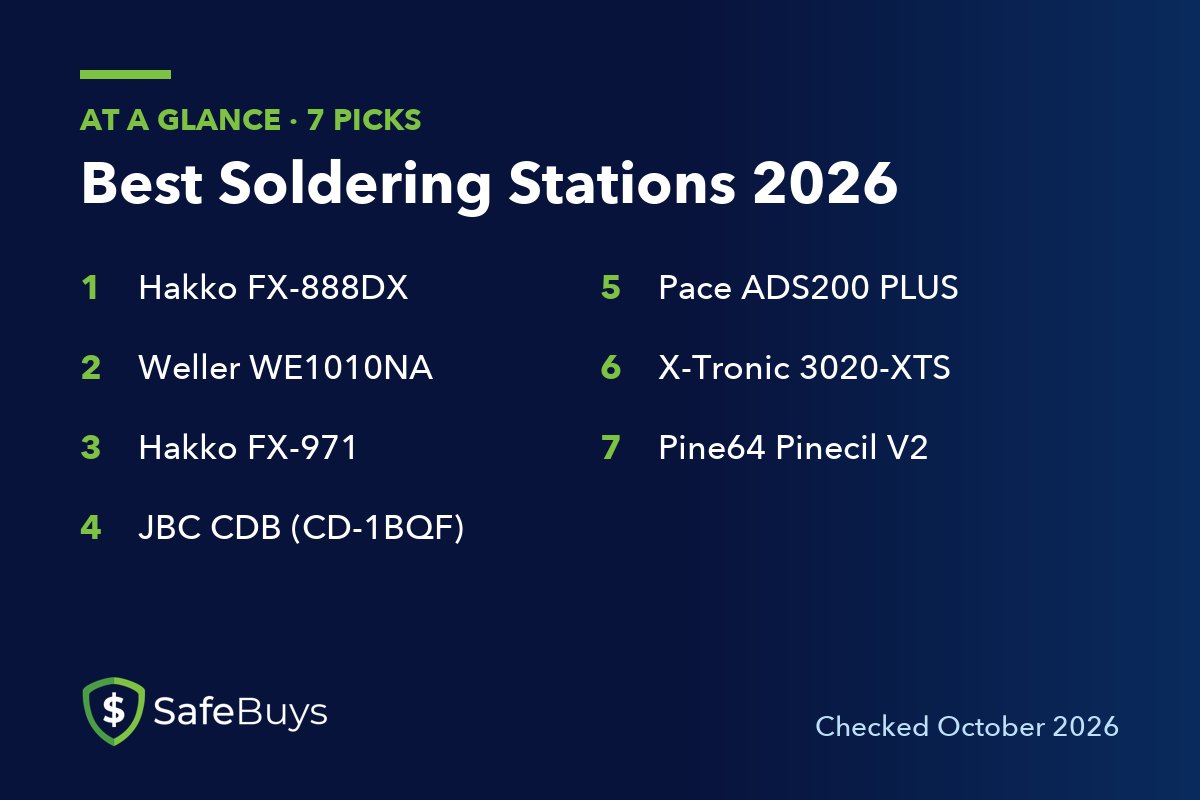
The best soldering stations for electronics in 2026 hold a set temperature, recover quickly on big joints and take tips you can still buy in ten years. For most hobbyists and repair benches the Hakko FX-888DX is the one to buy. It is a temperature-controlled station with a 65 W iron, a 50 to 480°C range, and it takes Hakko’s T18 series tips.
This guide is for people who solder circuit boards: kit builders, students, repair techs and working engineers. It is not about plumbing irons or stained glass. The picks run from a starter station under $60 to cartridge-based professional units, plus one USB-C iron for a toolbox or field kit.
Last checked October 2026: availability, specs and prices.
What to Look for in Soldering Stations for Electronics
Real temperature control. A proper station measures tip temperature and adjusts power to hold it. Cheap “variable power” irons only change the wattage, so the tip overheats when idle and sags on a large joint. Every pick below is temperature controlled, and the makers publish a stability figure for most of them.
Tip system. There are two designs. Classic stations such as the Hakko FX-888DX and Weller WE1010NA use a separate heater with a plain tip that slides over it. Tips are cheap and easy to find. Cartridge stations such as the Hakko FX-971, JBC CDB and Pace ADS200 build the heater and sensor into the tip. They cost more per tip, but heat reaches the joint faster and tips can be swapped while hot.
Power and recovery. Wattage matters less for reaching temperature than for staying there. Ground planes, connectors and thick wires pull heat out of a tip. A 65 to 70 W classic iron handles most through-hole and surface-mount work. For heavy boards, look at 95 W and higher cartridge systems.
Temperature range. Leaded and lead-free solders need different settings, and lead-free runs hotter. A range that reaches 450°C or so covers both with room to spare.
ESD safety. Modern chips are sensitive to static. An ESD-safe station grounds the tip so stray charge does not pass through the part you are soldering. All the bench stations here are sold as ESD safe.
Sleep and setback. Tips wear fastest when they sit hot and unused. A stand or timer that drops the temperature when the iron is parked makes tips last much longer.
Best Soldering Stations for Electronics: Our Picks
The seven products below were listed as current by their makers when checked. Prices are shown only where a store price was confirmed.
1. Hakko FX-888DX
The Hakko FX-888DX is the current version of Hakko’s FX-888 station. The headline change is a rotary encoder: you turn the knob to set the temperature and press it to confirm. Hakko has also added titanium silver and sunflower yellow colors.
Hakko lists a 65 W iron with a ceramic heater, a 50 to 480°C range and temperature stability of plus or minus 1°C at idle. An adjust mode corrects the display against a measured tip temperature. The station takes T18 series tips and accepts optional handpieces, among them a 95 W iron for heavy joints and SMD hot tweezers. DigiKey listed it in stock at about $134 (October 2026).
Pros of the Hakko FX-888DX
- Simple knob control for temperature
- Stability of plus or minus 1°C at idle, per Hakko
- Takes Hakko T18 series tips
- Optional 95 W iron and hot tweezers plug into the same base
Cons of the Hakko FX-888DX
- Classic heater-and-tip design is slower on heavy joints than cartridge stations
- Tips cannot be swapped quickly while hot
2. Weller WE1010NA
The Weller WE1010NA is the Hakko’s direct rival. It is an 85 W station with a 70 W iron, a 100 to 450°C range and ET series tips that change without tools. Weller gives a heat-up time of about 28 seconds from 50 to 350°C.
Its extras suit a classroom or shared bench. Standby mode and auto setback save energy and tip life, and settings can be locked with a password so nobody cranks the heat to maximum. Weller rates temperature stability at plus or minus 6°C, looser than Hakko’s figure. Weller’s list price is about $198 (October 2026).
Pros of the Weller WE1010NA
- 70 W iron with toolless tip change
- Standby, auto setback and password lock
- ESD safe
Cons of the Weller WE1010NA
- Stability rating is wider than the FX-888DX
- List price is well above the FX-888DX’s street price
3. Hakko FX-971
The Hakko FX-971 is the step up to cartridge tips. It is a compact 100 W station with a 95 W iron that weighs just 31 g with a tip fitted. Hakko says its patented T39 composite tips improve sensor response and heat transfer, and that cycle time is cut by about 40%.
The range is 50 to 450°C with stability of plus or minus 3°C at idle. The display tilts so it can be read on or under a bench. For shops that track calibration, the station accepts readings from Hakko’s FG-100B and FG-101B thermometers over infrared, and PC software logs set temperature and tip temperature history.
Pros of the Hakko FX-971
- 95 W cartridge iron in a small station
- Very light handpiece
- Infrared calibration and PC logging
Cons of the Hakko FX-971
- Stability rating of plus or minus 3°C is looser than the FX-888DX’s
- More station than a casual hobbyist needs
4. JBC CDB (CD-1BQF)
The JBC CDB is JBC’s compact station for general-purpose work, and the entry point to its C245 cartridge range. The 120 V version is the CD-1BQF. It comes with JBC’s T245-A general purpose handle and uses C245 cartridges, with a 90 to 450°C range and 130 W peak power.
JBC’s selling point is tip life as much as speed. The station has sleep and hibernation modes, and JBC says these extend tip life up to five times. One thing to know before ordering: the cartridge is not included, so add at least one C245 tip to the cart.
Pros of the JBC CDB
- 130 W peak power through C245 cartridges
- Sleep and hibernation modes that protect tips
- Wide 90 to 450°C range
Cons of the JBC CDB
- No cartridge in the box
- No price on JBC’s site; it is sold through distributors
5. Pace ADS200 PLUS
The Pace ADS200 PLUS is a production station that undercuts most cartridge systems. Pace lists up to 120 W, a 193 to 454°C (380 to 850°F) range and hot-swappable tip-heater cartridges. Its AccuDrive control senses load and delivers power on demand.
Both the station housing and the TD-200 iron are aluminum, which Pace pitches as rugged enough for a factory line. The kit includes the iron, one tip and a stand that holds up to seven tips, with a sponge and brass wool. An Instant SetBack stand is optional. It is sold in 120 V and 230 V versions and costs about $319 (October 2026) from Pace.
Pros of the Pace ADS200 PLUS
- Up to 120 W with hot-swappable cartridges
- Aluminum station and iron
- Tested to ESD standards, per Pace
Cons of the Pace ADS200 PLUS
- The setback stand costs extra
- Minimum setting of 193°C is higher than the Hakko, Weller and JBC stations
6. X-Tronic 3020-XTS
The X-Tronic 3020-XTS is the starter pick. It is a 75 W station, with 60 W going to the iron, and a 200 to 480°C range shown on a blue LED readout. X-Tronic lists PID control with stability of plus or minus 2°C and an ESD-safe design.
A 10-minute sleep timer cools the iron when it is left in the holder, and a switch flips between Celsius and Fahrenheit. The box is generous: solder, a brass tip cleaner with flux, a sponge, two helping hands and a silicone mat. X-Tronic backs it with a three-year warranty and sells it for about $55 (October 2026).
Pros of the X-Tronic 3020-XTS
- Temperature controlled at a very low price
- Sleep timer and plenty of accessories included
- Three-year warranty
Cons of the X-Tronic 3020-XTS
- Lowest-powered iron among the bench stations here
- Minimum setting of 200°C is high for low-temperature work
7. Pine64 Pinecil V2
The Pine64 Pinecil V2 is not a station. It is a pen-size smart iron that earns a place here because it does a station’s job from a USB-C charger. It runs on USB-C PD or QC 3.0 at 12 to 20 V, or on a 12 to 24 V DC barrel supply.
The temperature adjusts from 100 to 400°C on a small OLED display, and the iron runs the open-source IronOS firmware. Pine64 says it reaches operating temperature in six seconds and drops into standby on its own when idle. It costs about $26 (October 2026) from Pine64’s store.
Pros of the Pinecil V2
- Fits in a pocket or laptop bag
- Runs from USB-C PD or a DC supply
- Open-source firmware with automatic standby
Cons of the Pinecil V2
- Needs a suitable USB-C PD charger or DC supply to perform well
- Tiny 0.69-inch display
- Tops out at 400°C
Soldering Station Buyer Questions
How many watts do I need for electronics?
For circuit boards, a temperature-controlled iron of 60 to 70 W is enough for most work. Control matters more than raw wattage. Step up to a 95 W or higher cartridge system if you often solder to large ground planes, shields or heavy connectors.
What temperature should I solder at?
Use the lowest setting that makes a quick, shiny joint. Lead-free solder needs more heat than leaded solder. If a joint takes more than a few seconds, the fix is usually a bigger tip, not a higher number on the dial.
Are cartridge tips worth the extra money?
For daily use, yes. The heater and sensor sit inside the tip, so the station reacts faster to a cold joint, and you can change tip shapes mid-job. For a few projects a month, a classic station like the Hakko FX-888DX costs less to buy.
Do I need an ESD-safe soldering station?
If you work on anything with integrated circuits, yes. It is a standard feature on every bench station in this guide, so there is little reason to buy one without it.
Related reading
- Best Multimeters for Electronics Hobbyists in 2026
- Rigol vs Siglent Oscilloscopes: Which Entry-Level Scope Should You Buy?
Conclusion
Buy the Hakko FX-888DX if you want one station for hobby and repair work that will last for years. The Weller WE1010NA is the better choice for classrooms and shared benches thanks to its password lock and setback features.
If you solder every day, move to cartridge tips: the Hakko FX-971 for a compact bench, the Pace ADS200 PLUS for value, or the JBC CDB if budget allows. Beginners can start with the X-Tronic 3020-XTS, and the Pinecil V2 belongs in any toolbox as a portable second iron.