
Best Bench Power Supplies for Electronics Hobbyists in 2026

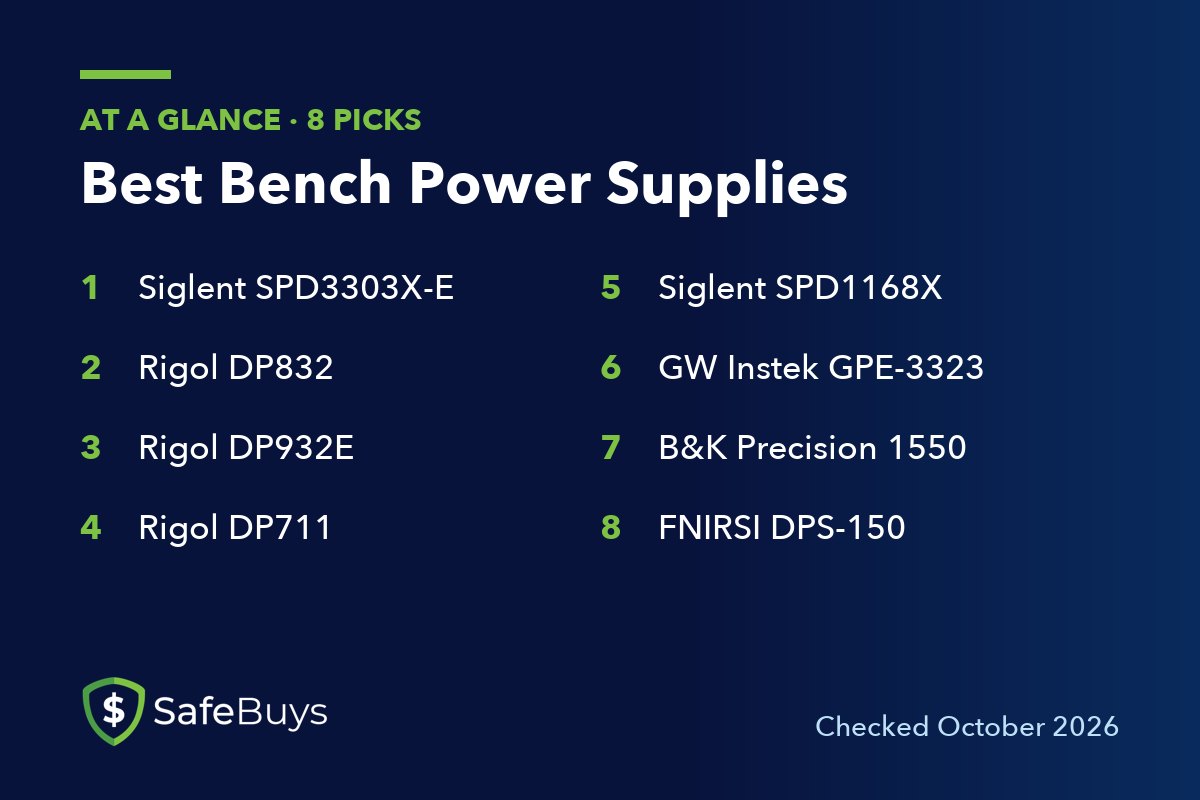
The best bench power supply for most electronics hobbyists is the Siglent SPD3303X-E. It is a linear, three-output supply with two adjustable 0 to 32 volt, 0 to 3.2 amp channels and a third channel for 2.5, 3.3 or 5 volt logic, and it lists for about $460. If you only need one output, the Rigol DP711 gives you a linear 30 volt, 5 amp supply for about $350.
This guide is for people building and repairing circuits at home. It covers programmable linear supplies from the main test-equipment brands, plus two switching supplies for tighter budgets. For each pick you will find whether it is linear or switching and the voltage and current ranges its maker publishes.
Last checked October 2026: availability, specs and prices.
What to Look for in a Bench Power Supply
Linear or switching. A linear supply uses a heavy mains transformer and regulates by burning off spare voltage as heat. It is big and inefficient, but its output is very clean, which matters for audio and radio work. A switching supply chops the voltage at high frequency. It is small, light and cheap, with more ripple and noise. For digital projects and motors, that is usually fine.
Voltage and current range. Around 30 volts and 3 to 5 amps covers most hobby work.
Number of outputs. One output is enough for simple projects. Two adjustable outputs let you make the positive and negative rails that op-amp circuits need.
Current limiting. Every supply here has constant-voltage and constant-current modes. Set the current limit low before powering a new board and a wiring mistake costs you nothing.
Resolution and noise. Entry models here set voltage in 10 millivolt steps, better ones in 1 millivolt steps. For noise, compare the maker’s ripple figures: the linear supplies here are specified in microvolts RMS.
Best Bench Power Supplies: Our Picks
1. Siglent SPD3303X-E
Type: linear. Range: two channels of 0 to 32 V and 0 to 3.2 A, plus one channel of 2.5, 3.3 or 5 V at up to 3.2 A.
The Siglent SPD3303X-E is the supply most hobbyists should start with. Siglent describes the SPD3303X family as programmable linear DC power supplies with three isolated outputs and 220 watts in total. The two main channels work independently, in series for up to 60 volts, or in parallel for up to 6.4 amps.
It has a 4.3 inch color LCD, USB control with SCPI commands and Siglent’s free EasyPower PC software. Resolution on this model is 10 millivolts and 10 milliamps. The dearer SPD3303X is the same supply with 1 millivolt and 1 milliamp resolution. Siglent lists the X-E at about $460 (October 2026). Its US store showed new inventory due in early December when this page was checked, so look at distributor stock too.
Pros of the Siglent SPD3303X-E
- Three isolated outputs from a linear design
- Series and parallel modes for 60 V or 6.4 A
- Color display, USB control and free PC software
Cons of the Siglent SPD3303X-E
- 10 mV and 10 mA resolution, coarser than the SPD3303X
- Heavy: Siglent’s store lists the weight as 20 pounds
2. Rigol DP832
Type: linear. Range: three channels, up to 30 V and 3 A, 195 W total.
The Rigol DP832 is the long-standing rival to the Siglent. Rigol describes the DP800 series as a family of linear power supplies and lists the DP832 with three channels, 195 watts, a 30 volt maximum and a 3 amp maximum. One channel is isolated from the others.
Rigol specifies ripple and noise below 350 microvolts RMS and 2 millivolts peak to peak, with a transient response under 50 microseconds. The supply measures voltage, current and power and has a programmable timer. Rigol was selling it for about $405 (October 2026), a reduction from its usual list price, with a quoted lead time of eight weeks.
Pros of the Rigol DP832
- Three channels with very low specified ripple
- Built-in voltage, current and power measurement with waveform display
- Programmable timer
Cons of the Rigol DP832
- Eight-week lead time from Rigol in October 2026
- High resolution, LAN and RS-232 are paid options on the standard model
3. Rigol DP932E
Type: linear. Range: three channels, 198 W total, with listed maximums of 60 V and 6 A.
The Rigol DP932E is the entry model in Rigol’s newer DP900 series, which the company calls a programmable linear DC power supply. Rigol’s table lists three channels and 198 watts in total, with a maximum of 60 volts and 6 amps. Channels 1 and 2 can be joined in series or parallel with one key, so there is no need to wire the outputs together yourself.
The front panel is a 4.3 inch color touchscreen. Ripple and noise are specified at under 350 microvolts RMS or 2 millivolts peak to peak across 20 Hz to 20 MHz. It was in stock at about $500 (October 2026).
Pros of the Rigol DP932E
- Touchscreen with one-key series and parallel combining
- Low specified ripple from a linear design
- In stock from Rigol when checked
Cons of the Rigol DP932E
- Costs more than the DP832 and SPD3303X-E
- High resolution is a paid add-on
4. Rigol DP711
Type: linear. Range: one output, up to 30 V and 5 A, 150 W.
The Rigol DP711 is the best single-output choice. Rigol calls the DP700 series an affordable, programmable linear DC power supply for benchtop use. The DP711 delivers up to 30 volts and 5 amps.
Rigol specifies noise under 500 microvolts RMS and 3 millivolts peak to peak. It has overvoltage and overcurrent protection and a timed output. The DP711 was in stock at about $350 (October 2026).
Pros of the Rigol DP711
- Full 5 A from a single linear output
- Small footprint next to the three-channel supplies
- Overvoltage and overcurrent protection
Cons of the Rigol DP711
- One output, so no split rails
- 1 mV and 1 mA resolution costs extra
5. Siglent SPD1168X
Type: linear. Range: one output, 0 to 16 V and 0 to 8 A, 128 W.
The Siglent SPD1168X is the pick for low-voltage, high-current work such as LED strips, 12 volt automotive electronics and battery-powered designs. Siglent describes the SPD1000X as a programmable linear DC power supply. This model covers 0 to 16 volts at up to 8 amps.
Unlike the entry three-channel supplies, it has 1 millivolt and 1 milliamp resolution as standard. It also has four-wire remote sense, which compensates for up to 1 volt lost in the leads, a useful feature at 8 amps. Ripple is specified at no more than 350 microvolts RMS and 3 millivolts peak to peak. It has a 2.8 inch color display and USB control. Siglent had it in stock at about $305 (October 2026). The SPD1305X is the same design with a 0 to 30 volt, 0 to 5 amp output, and it was on backorder.
Pros of the Siglent SPD1168X
- 1 mV and 1 mA resolution as standard
- Four-wire remote sense
- 8 A from a compact linear supply
Cons of the Siglent SPD1168X
- 16 V ceiling rules out 24 V projects
- Single output
6. GW Instek GPE-3323
Type: linear. Range: three channels, 217 W total; channels 1 and 2 combine for 32 V at 6 A in parallel or 64 V at 3 A in series.
The GW Instek GPE-3323 suits people who want knobs and a clear display more than computer control. GW Instek places the GPE-X323 series among its non-programmable supplies and describes it as an economy linear DC power supply.
It has a 4.3 inch LCD, automatic tracking for series and parallel operation on channels 1 and 2, an output on/off control with a remote input, and a key lock. Setting and readback resolution is 100 millivolts and 10 milliamps. GW Instek lists it at about $497 (October 2026) and sells through distributors.
Pros of the GW Instek GPE-3323
- Linear, three-channel design with tracking
- Simple panel with key lock and output switch
Cons of the GW Instek GPE-3323
- 100 mV voltage resolution
- No programming or PC logging
7. B&K Precision 1550
Type: switching. Range: one output, 1 to 36 V and 0 to 3 A, 108 W.
The B&K Precision 1550 is a compact switching bench supply. B&K describes it as a 108 watt unit for labs, workshops and schools where bench space is limited. It gives 1 to 36 volts at up to 3 amps from an isolated output, with constant-voltage and constant-current operation, overvoltage protection, an output on/off control and a large LCD.
Note the 1 volt minimum: it does not go down to zero like the linear supplies above. There is a USB charging port on the front panel. B&K lists it at $215 with a one-year warranty, and its page showed stock at several major distributors in October 2026. The standard model is for 110 volt mains.
Pros of the B&K Precision 1550
- Compact for a 108 W supply
- Reaches 36 V
- Front USB charging port and output switch
Cons of the B&K Precision 1550
- Switching design, not linear
- Output starts at 1 V, not 0 V
8. FNIRSI DPS-150
Type: switching (step-down). Range: one output, 0 to 30 V and 0 to 5 A, up to 150 W, limited by the input.
The FNIRSI DPS-150 is a pocket-size supply for small benches and tight budgets. FNIRSI sells it as a mini programmable switching power supply. It has no mains transformer of its own. Instead it takes DC power through a USB Type-C input from a PD or QC fast charger, a power bank or a DC adapter. The spec table gives the input range as 5 to 32 volts, though FNIRSI’s own precautions recommend staying between 5 and 30 volts.
Because it only steps voltage down, FNIRSI warns that the input must be higher than the output you want. In practice the output you can reach depends on the supply you plug in. It has a 2.8 inch screen and weighs about 178 grams. The version without a power adapter was about $58 (October 2026), a sale price.
Pros of the FNIRSI DPS-150
- Very cheap and pocket-size
- Runs from a USB-C PD charger or power bank
- Weighs about 178 grams
Cons of the FNIRSI DPS-150
- Output is capped by the charger or adapter you feed it with
- Switching design with no ripple figure on the product page
Bench Power Supplies: Common Questions
Is a linear or switching bench power supply better for a hobbyist?
If you can afford it and have the bench space, linear. The clean output removes one source of doubt when a circuit misbehaves. A switching supply makes sense when price, size or weight matters more.
How many volts and amps do I need?
Most hobby electronics run on 3.3, 5, 9, 12 or 24 volts and draw well under 3 amps. A 30 volt, 3 amp supply covers nearly all of it. Go for 5 amps or more if you work with motors, LED lighting or car electronics.
Can I use a bench power supply to charge batteries?
Constant-current, constant-voltage supplies are often used that way, but they are not chargers and will not stop on their own. Follow the battery maker’s limits and never leave it unattended. FNIRSI, for one, advises fitting a reverse-current protection diode when charging batteries from the DPS-150.
Related reading
- Best Multimeters for Electronics Hobbyists in 2026
- Rigol vs Siglent Oscilloscopes: Which Entry-Level Scope Should You Buy?
Conclusion
Buy the Siglent SPD3303X-E if you want one bench power supply that will cover almost any hobby project: it is linear, has three outputs and can be run from a PC. The Rigol DP832 is the direct alternative, and the Rigol DP932E adds a touchscreen for more money. For a single clean output, choose the Rigol DP711 for 30 volts or the Siglent SPD1168X for high current at low voltage. If your budget is closer to $200, the switching B&K Precision 1550 is a proper mains-powered bench unit, and the FNIRSI DPS-150 is a cheap, portable way to start.