

Best Power Banks for Laptops in 2026

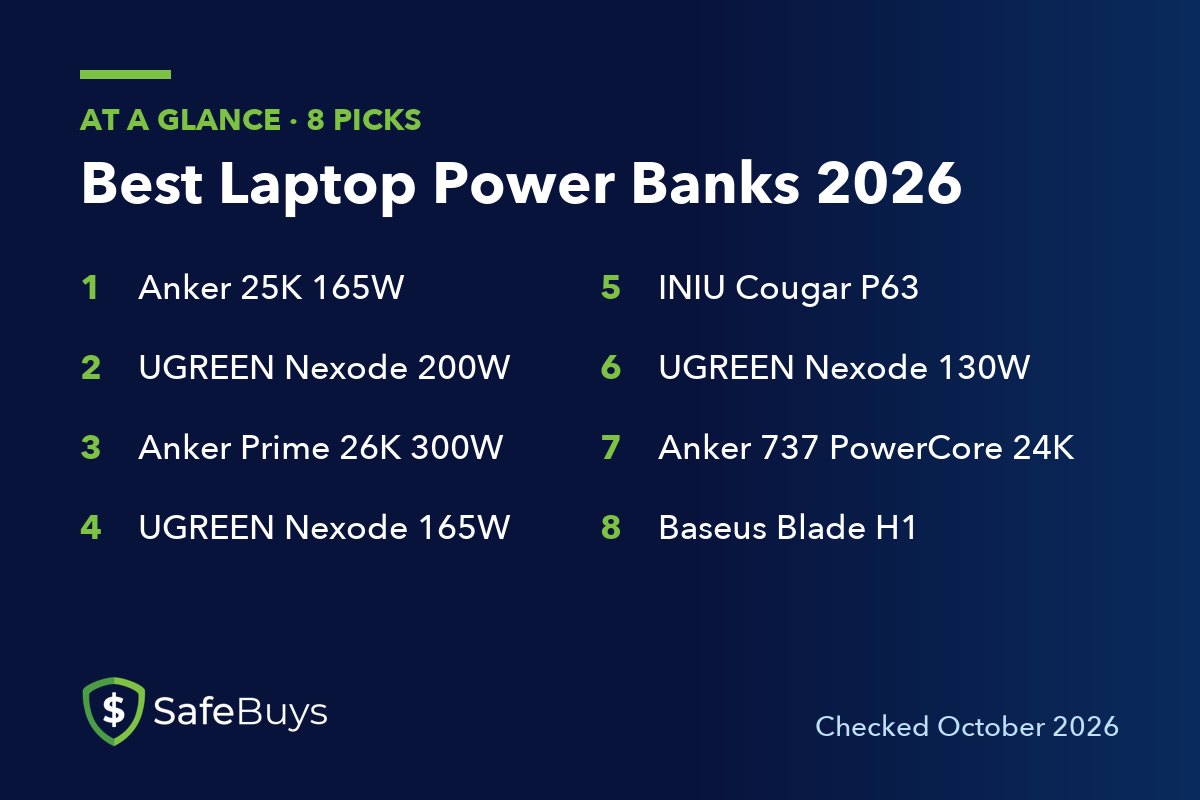
The best power banks for laptops in 2026 put out 65 W or more over USB-C Power Delivery and hold close to the 100 Wh airline limit. For most people the Anker Laptop Power Bank (25K, 165W) is the one to buy. It charges a laptop at up to 100 W, has two built-in USB-C cables, and Anker markets it as flight-approved.
This guide is for people who work away from an outlet: on flights, trains, job sites and long days on campus. A phone-size power bank will not do the job. Laptops need higher voltage and far more energy, so the short list below only includes models their makers rate for 100 W or more.
Last checked October 2026: availability, specs and prices.
What to Look for in Power Banks for Laptops
Single-port wattage, not the total. The big number on the box is usually the combined output of all ports. What matters for a laptop is what one USB-C port can deliver. Check the wattage printed on your laptop’s own charger and match it. A 100 W port covers most thin-and-light and mid-size laptops. Laptops that ship with 140 W chargers need a port rated at 140 W to charge at full speed.
Capacity in watt-hours. Milliamp-hours (mAh) are a poor guide for laptops, because the figure depends on the voltage it is quoted at. Watt-hours (Wh) tell you the real energy. The FAA gives the formula: multiply the battery voltage by the amp-hours. Expect less at the laptop than the label says. Anker’s own product pages put conversion losses at roughly 30% to 45%.
The airline carry-on limit. The TSA says power banks must be packed in carry-on bags and are prohibited in checked luggage. The FAA limits lithium-ion batteries to 100 Wh each. With airline approval, a passenger may carry up to two larger spares of 101 to 160 Wh. The FAA also notes that airlines may set stricter limits, so check with yours. Every pick below is sold as being under the 100 Wh line.
Recharge speed. A big battery is slow to refill through a weak input. Look for 65 W input or better. The fastest models here take 100 W or more.
Weight and shape. Laptop-class power banks weigh from about 390 g to 630 g. Most are brick-shaped. One pick is flat, which matters if it rides in a laptop sleeve.
Cables and display. Built-in cables mean one less thing to forget. A display that shows watts in and out helps you confirm the laptop is really charging at the speed you paid for.
Best Power Banks for Laptops: Our Picks
All eight were in stock on their makers’ own stores when checked. Capacity is given in mAh and, where the maker publishes it, in Wh.
1. Anker Laptop Power Bank (25K, 165W)
The Anker Laptop Power Bank (25K, 165W) has a 25,000 mAh battery and three USB-C outputs: one port and two attached cables, which Anker describes as built-in and retractable. Each can deliver up to 100 W, and any two together share 165 W. There is also a 33 W USB-A port, so four devices can charge at once.
Anker lists a 100 W input and says a full recharge takes about two hours with a 100 W charger. It weighs 595 g and has a screen that shows battery percentage and port status. Anker’s page gives the capacity in mAh only and labels the pack flight-approved, so check the Wh figure printed on the unit before you fly. It costs about $120 (October 2026).
Pros of the Anker 25K 165W
- Up to 100 W from each USB-C output
- Two attached USB-C cables, so there is nothing extra to pack
- 100 W input for a recharge in about two hours
Cons of the Anker 25K 165W
- Tops out at 100 W per port, short of 140 W laptops
- Wh rating is not shown on the product page
2. UGREEN Nexode Power Bank 25000mAh 200W
The UGREEN Nexode 25000mAh 200W is the pick for laptops with 140 W chargers. UGREEN lists the capacity as 25,000 mAh (90 Wh). The first USB-C port delivers up to 140 W over PD 3.1 and the second up to 100 W, so it can run two laptops at once. A USB-A port handles a phone.
The TFT display shows remaining battery, voltage, current, input and output in real time. The pack weighs 609 g. Its weak point is the 65 W input, which is modest for a battery this size. The list price is about $130 (October 2026).
Pros of the UGREEN 200W
- 140 W from one USB-C port, 100 W from the other
- 90 Wh capacity stated by the maker
- Detailed real-time display
Cons of the UGREEN 200W
- 65 W maximum input
- At 609 g, one of the heavier packs here
3. Anker Prime Power Bank (26K, 300W)
The Anker Prime Power Bank (26K, 300W) is the high-end choice. Anker states 26,250 mAh (99.75 Wh), which sits just under the FAA’s 100 Wh line. Each of its two USB-C ports delivers up to 140 W, a USB-A port adds 22.5 W, and total output reaches 300 W.
Recharging is the standout. Anker says the pack accepts up to 250 W through both USB-C ports together and reaches 50% in 13 minutes, a figure from its own lab tests that requires two 140 W chargers and 5 A cables. It weighs 600 g, has a smart display and can be controlled from an app. The price is about $230 (October 2026).
Pros of the Anker Prime 26K
- Two 140 W USB-C ports
- 99.75 Wh, close to the most you can fly with unapproved
- Very fast dual-port recharging, per Anker
Cons of the Anker Prime 26K
- Costs about twice as much as the other picks
- Top recharge speed needs two 140 W chargers
4. UGREEN Nexode Power Bank 25000mAh 165W
The UGREEN Nexode 25000mAh 165W is UGREEN’s answer to the Anker at the top of this list. It has two built-in braided USB-C cables and can charge up to four devices at once from a 25,000 mAh pack that UGREEN rates at 90 Wh.
UGREEN lists 90 W fast recharging and says a full refill takes about two hours. An LED display shows the remaining battery. The list price is about $110 (October 2026), and UGREEN’s store showed a coupon code below that when checked.
Pros of the UGREEN 165W
- Two built-in braided USB-C cables
- 90 Wh stated capacity
- Recharges in about two hours, per UGREEN
Cons of the UGREEN 165W
- Simpler display than the 200 W model
- Built-in cables cannot be swapped if they wear out
5. INIU Cougar P63 (25,000 mAh, 100W)
The INIU Cougar P63 is the light one. INIU lists it at 392 g and 11 x 7 x 3.6 cm, and claims it is 30% smaller than other 25,000 mAh, 100 W packs. For a bag you carry all day, that difference is easy to feel.
The main USB-C port delivers up to 100 W and takes up to 65 W in. A second USB-C port is rated at 45 W and the USB-A port at 18 W. INIU does not print a Wh figure for this model on its page. It says its power banks range from 37 Wh to 99.9 Wh, all under 100 Wh. The price was about $67 (October 2026).
Pros of the INIU P63
- 392 g, far lighter than the other 25,000 mAh picks
- 100 W from the main USB-C port
- Lowest price among the 25,000 mAh models
Cons of the INIU P63
- Output drops when several ports are in use
- No model-specific Wh figure on the product page
6. UGREEN Nexode Power Bank 20000mAh 130W
The UGREEN Nexode 20000mAh 130W trades some capacity for size. UGREEN lists 20,000 mAh (72 Wh) and a weight of 476 g. The first USB-C port delivers up to 100 W, the second 30 W, and the USB-A port 22.5 W.
Input is 65 W and the display is the same TFT type as the 200 W model. With 72 Wh on board it will not fully refill a large laptop, but it is a sensible size for a 13-inch or 14-inch machine. The list price is about $90 (October 2026).
Pros of the UGREEN 130W
- 100 W USB-C port in a 476 g pack
- 72 Wh, well under the airline limit
- TFT display
Cons of the UGREEN 130W
- Second USB-C port is only 30 W
- Less energy than the 25,000 mAh picks
7. Anker 737 Power Bank (PowerCore 24K)
The Anker 737 Power Bank is an older design that Anker still sells, and it remains a straightforward way to get 140 W. It has a 24,000 mAh battery, two USB-C ports and one USB-A port, with 140 W maximum output and 140 W two-way charging through USB-C.
It weighs 630 g and has a smart digital display. Anker’s page lists the capacity in mAh only. It costs about $110 (October 2026).
Pros of the Anker 737
- 140 W USB-C output and input
- Long-running model with hundreds of owner reviews on Anker’s store
Cons of the Anker 737
- Heaviest pick at 630 g
- No built-in cables
- Wh rating is not shown on the product page
8. Baseus Blade H1 (20,000 mAh, 100W)
The Baseus Blade H1 is the flat one. Baseus lists it at 1.8 cm thick and about 451 g, a shape that slides into a laptop sleeve where a brick will not.
It has a 20,000 mAh battery, four ports, 100 W maximum output, a digital display and pass-through charging. Baseus lists a 60 W input and a charge time of 1.5 hours. The page does not give a Wh figure. It was priced at about $90 (October 2026).
Pros of the Baseus Blade H1
- Thin, flat body that packs next to a laptop
- 100 W output and four ports
Cons of the Baseus Blade H1
- Larger footprint than a brick-style pack
- No Wh figure on the product page
Laptop Power Bank Questions
Can I take a laptop power bank on a plane?
Yes, in your carry-on only. The TSA prohibits power banks in checked bags. The FAA limit is 100 Wh per battery without approval, and up to two spares of 101 to 160 Wh with airline approval. If a carry-on is gate-checked, the FAA says power banks must be removed and kept with you in the cabin.
How many watts does my laptop need?
Read the output printed on the charger that came with it. A power bank with a lower rating will often still charge the laptop, just more slowly, and may not keep up under heavy load.
How many times will a 25,000 mAh power bank charge a laptop?
Usually about once. A 25,000 mAh pack holds around 90 Wh, and some of that is lost in conversion. Anker says its 99.75 Wh Prime model charges a MacBook Pro (M4) up to 0.8 times.
Do I need a special cable?
For 100 W and above, yes. Use a USB-C cable rated for 5 A, or 240 W for a 140 W port. An ordinary phone cable will limit the charging speed.
Related reading
- Anker Nano Power Bank (10K, 45W) Review: The PowerCore 10000 QC 3.0 Successor
- The 5 Best Laptops for Listening to Music in 2026
Conclusion
Buy the Anker Laptop Power Bank (25K, 165W) if your laptop charges at 100 W or less: the built-in cables and fast recharge make it the easiest to live with. If your laptop came with a 140 W charger, choose the UGREEN Nexode 200W, or the Anker Prime 26K if you also want the fastest recharge and the most capacity you can fly with.
Travelers who count grams should look at the INIU Cougar P63, and the Baseus Blade H1 suits anyone who wants a flat pack in a laptop sleeve. For a smaller laptop, the 72 Wh UGREEN Nexode 130W is enough.