

Best Bookshelf Speakers Under $200 in 2026

A pair of bookshelf speakers is the biggest sound upgrade you can make for under $200. Compared with a TV’s built-in speakers or a single Bluetooth box, two separate cabinets give you real stereo, clearer voices and bass you can feel on a desk or a shelf.
The first decision is powered or passive. Powered speakers have the amplifier inside and plug straight into a turntable, TV or computer. Passive speakers need a separate amplifier or receiver. The top powered pick is the Edifier R1280T, and the top passive pick is the Polk Monitor XT15. Both cost about $150 a pair.
Last checked October 2026: availability, specs and prices.
What to Look for in Bookshelf Speakers Under $200
Powered or passive. This matters more than any spec. If you do not own an amplifier or AV receiver, buy powered speakers. One cabinet holds the amp and connects to the other with a supplied wire. If you already have a receiver, or plan to build a surround system, buy passive speakers. Every pick below is labeled.
Inputs on powered models. Check what you plan to connect. RCA covers turntables with a built-in preamp, CD players and most computers with an adapter cable. Optical is the easy way to connect a TV. Bluetooth is for phones. A subwoofer output lets you add bass later.
Sensitivity and impedance on passive models. Sensitivity, in dB, tells you how loud a speaker plays for a given amount of power. Higher numbers are easier to drive with a small amp. Impedance, in ohms, should match what your amplifier supports. Most are 6 or 8 ohms.
Woofer size. At this price, woofers are 4 to 5.25 inches. Larger cones move more air and reach lower. A 4-inch speaker suits a desk. A 5.25-inch speaker is a better fit for a living room.
Port position. A rear port needs a few inches of space behind the cabinet. A front port is more forgiving if the speakers will sit against a wall or inside a shelf.
Warranty. Speakers last for decades when nothing goes wrong. Coverage here ranges from two years to lifetime.
Best Bookshelf Speakers Under $200: Our Picks
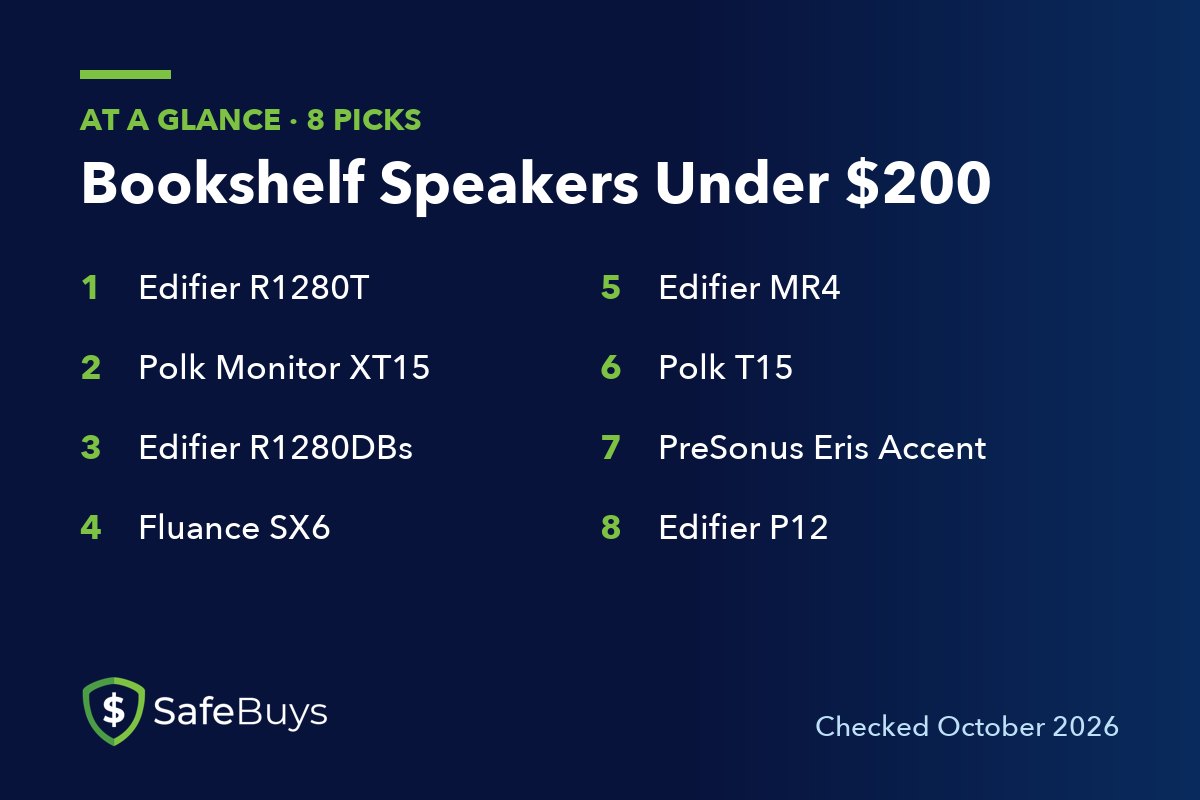
The eight pairs below were all on sale new in October 2026 for less than $200 a pair on the maker’s own store. Four are powered and four are passive.
1. Edifier R1280T (Powered)
The Edifier R1280T is the default answer for anyone who wants good sound with no extra boxes. Each speaker has a 4-inch bass driver and a 13mm silk dome tweeter, and the built-in amplifier is rated at 21W per channel.
Two sets of RCA inputs let you leave two sources connected at once, such as a turntable and a computer. A small remote handles volume and mute. There is no Bluetooth, which Edifier confirms in its own FAQ, so look at the R1280DBs below if you need it. Edifier sells the R1280T in wood and white finishes with a two-year warranty for about $150 (October 2026).
Pros of the R1280T
- Powered: no amplifier needed
- Two RCA inputs for two sources
- Remote control included
- Two-year warranty
Cons of the R1280T
- No Bluetooth, optical input or subwoofer output
- 4-inch woofers limit deep bass
2. Polk Monitor XT15 (Passive)
The Polk Monitor XT15 is the passive pick for a first hi-fi or home theater system. It needs an amplifier or receiver. Each cabinet has a 5.25-inch woofer and a 1-inch Terylene dome tweeter, and Polk states it is Hi-Res Audio certified with a response that extends to 40 kHz.
Polk lists sensitivity at 86 dB and recommends 30 to 150 watts per channel. It is compatible with 4-ohm and 8-ohm amplifier outputs. The XT15 also works as a surround speaker alongside larger Monitor XT models, and Polk describes it as compatible with Dolby Atmos and DTS:X receivers. Polk’s own store sells it for about $149 a pair (October 2026).
Pros of the Monitor XT15
- 5.25-inch woofers, larger than the powered picks
- Hi-Res Audio certified
- Part of a full range that can grow into surround sound
Cons of the Monitor XT15
- Passive: an amplifier adds to the total cost
- 86 dB sensitivity benefits from a reasonably powerful amp
3. Edifier R1280DBs (Powered)
The Edifier R1280DBs is the R1280T with the missing inputs added. It keeps the dual RCA inputs and 21W per channel, then adds Bluetooth 5.0, optical and coaxial digital inputs and a subwoofer output.
That makes it the best fit for a TV. The optical input takes the TV’s digital output directly, and Edifier says the sub output detects a connected subwoofer and switches on a digital crossover. The bass port is on the front. At about $200 (October 2026) it sits right at the limit of this guide.
Pros of the R1280DBs
- Powered, with Bluetooth, optical, coaxial and RCA inputs
- Subwoofer output for later upgrades
- Front port makes placement easier
Cons of the R1280DBs
- Costs about $50 more than the R1280T for the same amplifier power
- Only just under the $200 cap
4. Fluance SX6 (Passive)
The Fluance SX6 is a larger passive speaker with a strong warranty. It needs an external amplifier, which Fluance states on the product page. The two-way design uses a 5-inch polymer-treated woofer with a butyl rubber surround and a ferrofluid-cooled tweeter in an internally braced MDF cabinet.
Fluance lists sensitivity at 89 dB, impedance at 8 ohms and power handling at 30 to 100 watts. The port is on the rear, so leave some room behind it. Fluance backs the SX6 with a lifetime parts and labor warranty. It costs about $150 a pair (October 2026).
Pros of the SX6
- 89 dB sensitivity is easy on small amplifiers
- Lifetime parts and labor warranty
- Braced MDF cabinet
Cons of the SX6
- Passive: needs an amplifier
- Rear port needs space from the wall
- At 12.7 inches tall, large for a desk
5. Edifier MR4 (Powered)
The Edifier MR4 is a powered studio monitor. It is tuned for a flat response and has the connections that music makers need. Each speaker has a 1-inch silk dome tweeter and a 4-inch woofer, driven by 42W of Class-D power in total.
The rear panel has balanced TRS inputs for an audio interface, RCA inputs and an AUX input. Edifier gives it two sound modes: a monitor mode for mixing and a music mode for casual listening. Edifier sells it in black or white for about $170 (October 2026).
Pros of the MR4
- Powered, with balanced TRS inputs
- Monitor and music sound modes
- Compact enough for a desk
Cons of the MR4
- No Bluetooth or optical input
- No remote control listed
6. Polk T15 (Passive)
The Polk T15 is Polk’s entry-level passive speaker, which the company pitches as a first step into high-performance audio. It pairs a 5.25-inch woofer with a 0.75-inch dome tweeter and a front-firing bass port, so it tolerates being pushed against a wall.
Polk lists sensitivity at 89 dB, which means a modest receiver can drive it. The cabinet measures 6.5 by 10.63 by 7.25 inches and is wall-mountable, according to Polk’s comparison table. It costs about $149 a pair (October 2026), the same as the newer Monitor XT15.
Pros of the T15
- 89 dB sensitivity suits low-powered amps
- Front port and wall-mount option
- Compact cabinet
Cons of the T15
- Passive: needs an amplifier
- Smaller tweeter than the XT15 at the same price
- No Hi-Res Audio certification listed
7. PreSonus Eris Accent (Powered)
The PreSonus Eris Accent is a powered pair from a studio monitor brand, built for home listening. PreSonus rates it at 60W of Class D power, or 30W per side, which is the most of any powered pick here. The woofers are 4 inches.
The spec list shows stereo RCA and USB inputs, with volume, treble, bass and source controls. A remote control and a 3.5mm-to-RCA cable are in the box. It costs about $140 (October 2026), which makes it the cheapest powered pair in this guide.
Pros of the Eris Accent
- Powered, with 30W per side
- USB input for a computer
- Remote plus treble and bass controls
Cons of the Eris Accent
- No Bluetooth on this version
- 4-inch woofers
8. Edifier P12 (Passive)
The Edifier P12 is the low-cost passive pick at about $110 a pair (October 2026). Edifier calls it the company’s first passive bookshelf speaker. It has a 4-inch bass driver, a 19mm silk dome tweeter and an MDF cabinet with wall-mount brackets built in.
Read the numbers before you buy. Edifier rates it for just 5 to 20 watts at 6 ohms and lists sensitivity at about 79 dB, which is low. It is best used as a surround or rear speaker, or with a small desktop amplifier at modest volume. Speaker cable is included.
Pros of the P12
- Lowest price in this guide
- Built-in wall-mount brackets
- Speaker cable included
Cons of the P12
- Passive: needs an amplifier
- Low sensitivity and a 20-watt power limit
- Not suited to filling a large room
Bookshelf Speakers Under $200: Common Questions
Do bookshelf speakers need an amplifier?
Passive ones do. In this guide that means the Polk Monitor XT15, Fluance SX6, Polk T15 and Edifier P12. The Edifier R1280T, R1280DBs and MR4 and the PreSonus Eris Accent are powered and need only a wall outlet and a source.
Can I connect a turntable directly?
To powered speakers, yes, if the turntable has a built-in phono preamp or you add an external one. Use the RCA inputs. Passive speakers connect to the receiver or amplifier, not to the turntable.
Which bookshelf speakers under $200 work best with a TV?
The Edifier R1280DBs, because it has an optical input. The other powered picks need the TV to have an analog audio output or a separate converter.
Should I add a subwoofer?
Small woofers cannot reproduce the lowest bass. If that matters to you, pick a powered model with a subwoofer output, such as the R1280DBs, or use passive speakers with a receiver that has one.
Related reading
Conclusion
If you do not own an amplifier, buy the Edifier R1280T. Spend the extra on the Edifier R1280DBs if you need Bluetooth, a TV connection or a subwoofer output. The Edifier MR4 is the choice for music production, and the PreSonus Eris Accent is the least expensive powered pair with a USB input.
If you have a receiver, the Polk Monitor XT15 is the best passive starting point. The Fluance SX6 and Polk T15 are easier to drive with a small amp, and the SX6 adds a lifetime warranty. Keep the Edifier P12 for surround duty or a low-powered desktop setup.